ONE BIG BEAUTIFUL BILL ACT (OBBBA) – KEY TAX TAKEAWAYS

On July 4th, 2025, the One Big Beautiful Bill Act (OBBBA) was signed into law by President Trump. This bill introduces new provisions and also extends or makes permanent several of the provisions that were part of the Tax Cuts and Jobs Act of 2017 (TCJA). The TCJA was passed during President Trump’s first term and many of the provisions of that Act were scheduled to expire in 2025.

There are various tax changes resulting from the recent passing of the OBBBA. We wanted to highlight a few that we feel would be most likely to affect our clients.

Below is a summary of some of the key tax changes that may impact individuals and businesses.

Individual Tax Updates:

  • No Tax on Tips: This provision is in effect from 2025-2028. Qualified workers may deduct up to $25,000 of tip income.
  • No Tax on Overtime: Effective 2025-2028, up to $12,500 ($25,000 for joint filers) of overtime wages are deductible.
  • Tax Rates Remain Unchanged: The OBBBA makes the seven standard tax rates permanent from the 2017 TCJA. (10%, 12%, 22%, 24%, 32%, 35%, and 37%)
  • Standard Deduction: In 2017, the standard deductions were doubled. The Act makes those changes permanent and increases standard deductions to $15,750 for single filers and $31,500 for joint filers for 2025.
  • Personal Exemptions: Makes the elimination of personal exemptions permanent.
  • Mortgage Interest Deduction: The limit for mortgage interest deductions is permanently capped at $750,000 of mortgage debt. The limit previously was $1 million of debt.
  • Child Tax Credit: The child tax credit will permanently increase to $2,200, up from $2,000 previously.
  • Senior Tax Deduction: Those 65 and older will receive a bonus deduction of $6,000, $12,000 for married couples filing jointly. This phases out for single taxpayers whose income is $75,000 or more, or $150,000 or more for married taxpayers.
  • State and Local Tax Deduction: This deduction increased to $40,000 through 2029. In 2030, the State and Local Tax deduction will revert to $10,000.
  • Car Loan Interest Deduction: From 2025-2028, deduct up to $10,000 in interest on a loan for an automobile that is assembled in the USA. This phases out for single filers with a modified AGI over $100,000 and joint filers over $200,000.
  • Trump Accounts: New, tax-advantaged savings accounts that may be opened for children under 18 years old. Can contribute up to $5,000 per account per year. For US citizens born between 2025-2028, the federal government will make a one-time $1,000 contribution per child.
  • Green Energy Policies: Many of the clean energy tax incentives from the 2022 Inflation Reduction Act will be terminated. This includes terminating the residential clean energy tax credit as well as the energy efficient home credit.
  • Estate and Gift Tax Exemptions: The lifetime gift and estate tax exemption permanently increased to $15 million per person, or $30 million for married couples. This will be indexed for inflation in the future.
  • Charitable Contributions: For individuals who do not itemize, an above-the-line deduction of up to $1,000 for single filers or $2,000 for joint filers is allowed for charitable contributions.

Business Tax Updates:

  • Bonus Depreciation: The Act reinstates and makes permanent the 100% first-year bonus depreciation for property that was acquired after January 19, 2025.
  • Section 179 Increase: The maximum amount a taxpayer may expense is increased to $2.5 million under the Act, (increased from $1.25 million).
  • Domestic Research and Experimental Expenditures: Restores businesses ability to deduct domestic research or experimental expenditures paid or incurred beginning in 2025. Businesses with less than $30 million in revenue may elect to apply this retroactively back to January 1, 2022.
  • Qualified Business Income: The OBBBA makes the Section 199A deduction permanent.
  • 1099 Reporting Threshold Increase: Starting in 2026, the threshold for reporting income on a Form 1099 will increase from $600 to $2,000.
  • Opportunity Zones: The OBBBA permanently extends and makes modifications to the Opportunity Zone program, a program which offers tax incentives for investments made in qualified low-income communities.

The summarized list above is only an overview of a fraction of the changes implemented in the OBBBA. The full OBBBA text can be viewed online. We will continue to monitor legislative updates. Please don’t hesitate to contact us if you have any questions regarding these changes or how it may affect you or your business.

Wealth Management Summer Newsletter 2025

Past performance is no guarantee of future results.
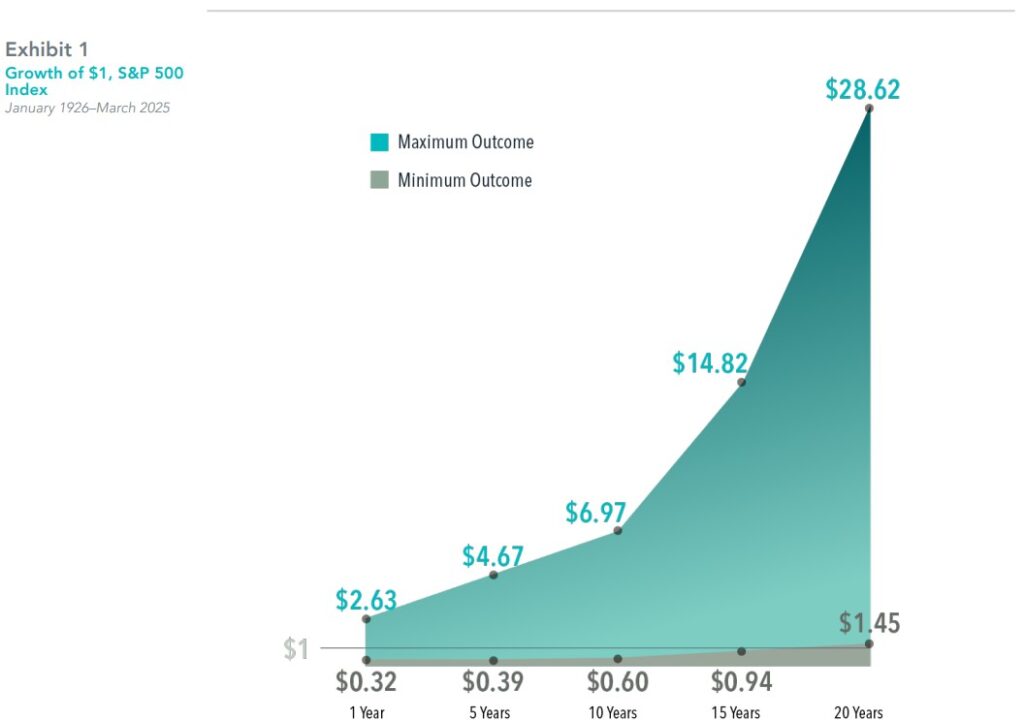
Growth of $1 computed over rolling monthly periods for the S&P 500 Index assumes reinvestment of income and no transaction costs or taxes. Outcomes are reported for the minimum and maximum of these observations. There are 1,180 overlapping one-year periods, 1,132 overlapping five-year periods, 1,072 overlapping 10-year periods, 1,012 overlapping 15-year periods, and 952 overlapping 20-year periods. The analysis is for illustrative purposes only and is not indicative of any investment. S&P data © 2025 S&P Dow Jones Indices LLC, a division of S&P Global. All rights reserved. Indices are not available for direct investment.
This article originally appeared in Above the Fray, a weekly newsletter for Dimensional clients.

Please see end of this post for important disclosures.

IS GOLD A SAFE HAVEN?

Not since the release of the third Austin Powers movie have I heard so much talk about gold. Stellar recent returns account for some of that — gold was up 25% year-to-date as of April 30. But another reason is the belief among some market participants that gold represents a safe haven, an asset to stabilize the portfolio when equity markets are choppy.

The problem with that story is gold has been far from immune to drawdowns. In fact, since 1970,
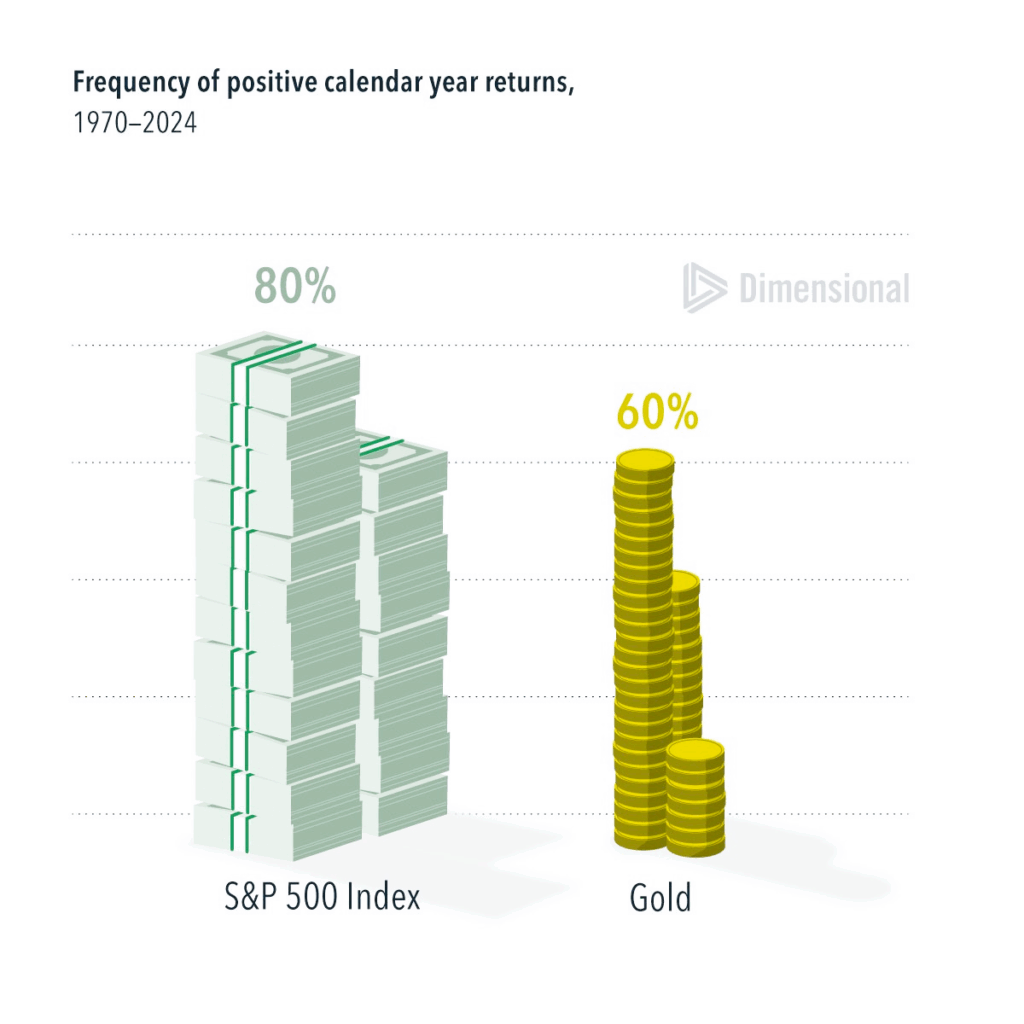
gold has been positive in just 60% of calendar years while the S&P 500 Index has been positive in 80%.
Investors hoping for a safe haven may not find it with gold.

Past performance is not a guarantee of future results. 
In USD. S&P data © 2025 S&P Dow Jones Indices LLC, a division of S&P Global. All rights reserved. Gold source: Bloomberg returns from composite prices. Indices are not available for direct investment; therefore, their performance does not reflect the expenses associated with the management of an actual portfolio.

Please see end of this post for important disclosures.

THE END OF AN ERA AND BEGINNING OF A NEW CHAPTER

Many made their annual voyage to Omaha, Nebraska for this year’s annual meeting for Berkshire Hathaway, which was held on May 3rd, 2025, to see and hear “the Oracle of Omaha” – Warren Buffett. This meeting marked an end of an era with Warren Buffett announcing that he would be stepping down at the end of 2025 as CEO of the company. He announced his recommendation of Greg Abel, Vice -Chairman of Non-Insurance Operations to succeed him as CEO of the company as of January 1, 2026. Buffett will remain as Chairman of the Board. The usual crowd-size for this event is somewhere around 40,000+ with people coming from around the world with many from China, again this year. Warren Buffett, who is 94 years old, ended the meeting after making his announcement of stepping down. With that, the crowd roared with applause, and rose to their feet to give Buffett a standing ovation. He laughingly responded by saying that their response to his announcement could be taken two ways.

It was also noteworthy this year that 2025 marked the 60th anniversary of Berkshire Hathaway which started in 1965. Honesty and integrity were virtues that Buffett tried to abide by in his management style of the company.

Many were there to latch on to some tidbit of information that they hoped could make them an automatic, overnight success at investing. Some were there to have just one more occasion to tap the knowledge and philosophies of Warren Buffett. His message is usually the same. That is, to not be easily influenced by the media when making investment decisions – stay rational. They often say that it is not how smart you are, but how able you are to control your emotional behavior that will determine how successful you are in investing. In responding to questions, he made several references to what Charlie Munger’s view might have been on many specific questions.

Volatility and uncertainty in the market seems to always be present, and no one knows what the future will hold. This is definitely true this year with all of the tariff negotiations that have been going on recently.

There is no way to predict how volatile the market will be in the future, but we are here to help when controlling your emotional behavior may not be an easy task. Contact us with your questions and any concerns, and enjoy your summer!

Disclosures for Longer Horizons Look Better for Stocks:
dimensional.com
Written By: Wes Crill, PhD, Senior Client Solutions Director and Vice President | Dimensional Fund Advisors – April 29, 2025
The information in this material is intended for the recipient’s background information and use only. It is provided in good faith and without any warranty or representation as to accuracy or completeness. Information and opinions presented in this material have been obtained or derived from sources believed by Dimensional to be reliable, and Dimensional has reasonable grounds to believe that all factual information herein is true as at the date of this material. It does not constitute investment advice, a recommendation, or an offer of any services or products for sale and is not intended to provide a sufficient basis on which to make an investment decision. Before acting on any information in this document, you should consider whether it is appropriate for your particular circumstances and, if appropriate, seek professional advice. It is the responsibility of any persons wishing to make a purchase to inform themselves of and observe all applicable laws and regulations. Unauthorized reproduction or transmission of this material is strictly prohibited. Dimensional accepts no responsibility for loss arising from the use of the information contained herein.
This material is not directed at any person in any jurisdiction where the availability of this material is prohibited or would subject Dimensional or its products or services to any registration, licensing, or other such legal requirements within the jurisdiction.
“Dimensional” refers to the Dimensional separate but affiliated entities generally, rather than to one particular entity. These entities are
Dimensional Fund Advisors LP, Dimensional Fund Advisors Ltd., Dimensional Ireland Limited, DFA Australia Limited, Dimensional Fund Advisors Canada ULC, Dimensional Fund Advisors Pte. Ltd., Dimensional Japan Ltd., and Dimensional Hong Kong Limited. Dimensional Hong Kong Limited is licensed by the Securities and Futures Commission to conduct Type 1 (dealing in securities) regulated activities only and does not provide asset management services.
RISKS
Investments involve risks. The investment return and principal value of an investment may fluctuate so that an investor’s shares, when redeemed, may be worth more or less than their original value. Past performance is not a guarantee of future results. There is no guarantee strategies will be successful.
UNITED STATES
Dimensional Fund Advisors LP is an investment advisor registered with the Securities and Exchange Commission.
Investment products: • Not FDIC Insured • Not Bank Guaranteed • May Lose Value
Dimensional Fund Advisors does not have any bank affiliates.

Disclosures for Is Gold a Safe Haven?:
dimensional.com
Written By: Wes Crill, PhD, Senior Client Solutions Director and Vice President | Dimensional Fund Advisors
Disclosures: All expressions of opinion are subject to change. This information is not meant to constitute investment advice, a recommendation of any securities product or investment strategy (including account type), or an offer of any services or products for sale, nor is it intended to provide a sufficient basis on which to make an investment decision. Investors should consult with a financial professional regarding their individual circumstances before making investment decisions. Diversification neither assures a profit nor guarantees against loss in a declining market.
Dimensional Fund Advisors LP is an investment advisor registered with the Securities and Exchange Commission.
Investment products: • Not FDIC Insured • Not Bank Guaranteed • May Lose Value
Dimensional Fund Advisors does not have any bank affiliates.

Investments provided through McMill Wealth Inc, a Nebraska Corporation, Registered Investment Advisor

This material is derived from sources believed to be reliable, but its accuracy and the opinions based thereon are not assured.

The articles and opinions in this publication are for general information only and are not intended to serve as specific financial, accounting or tax advice

REAL ID Deadline Fast Approaching

Andrew Steffensmeier

Specializes in small business preparation and planning, investment advisory services, business tax planning services

Email

After years of numerous delays, the REAL ID enforcement deadline is scheduled for May 7, 2025. 1

What is a REAL ID?

A REAL ID is a type of enhanced identification card that is signified by a star marking in the upper top portion of the card. The REAL ID Act, passed by Congress in 2005, set minimum security standards for state-issued driver’s licenses and identification cards. Everyone who is at least 18 years old will need a REAL ID-compliant driver’s license or identification card or another form of identification that is accepted by the Transportation Security Administration (TSA) for domestic air travel and to enter certain federal facilities.

Other TSA-acceptable documents are active passports, passport cards, or Global Entry cards. While standard driver’s licenses will no longer be a valid identification for TSA purposes, enhanced driver’s licenses from certain states are TSA-acceptable alternatives.

Although the TSA has announced that federal agencies are allowed to phase in their enforcement of the REAL ID requirement, travelers who don’t have a REAL ID by the May 7 deadline will face additional screening measures and possible delays at airport security checkpoints. You can visit the TSA website at tsa.gov for updates and information.

Finally, when traveling internationally, you will still need your passport for identification purposes, including travel to Canada or Mexico.

How do you get a REAL ID?

The U.S. Department of Homeland Security (DHS) oversees the enforcement and implementation of the REAL ID Act, but each state’s driver’s licensing agency has its own process for issuing REAL ID-compliant licenses/identification cards.

In order to obtain a REAL ID, you will need to provide documentation that shows your:

  • Full legal name, date of birth, proof of lawful presence (e.g., U.S. passport, birth certificate)
  • Social Security number (some states may not require physical documentation of your Social Security number)
  • Two proofs of address of principal residence (e.g., driver’s license, utility bill)

If you have had a name change (e.g., marriage, divorce, or court order), you will also need to bring in documentation that demonstrates proof of your name change. States may impose additional requirements, so be sure to contact your state’s driver’s licensing agency for more information.

1) U.S. Department of Homeland Security, 2025

If you are unable to get a REAL ID by the deadline, you can still fly using a passport or other TSA-acceptable document.

IMPORTANT DISCLOSURES

Broadridge Investor Communication Solutions, Inc. does not provide investment, tax, legal, or retirement advice or recommendations. The information presented here is not specific to any individual’s personal circumstances.

To the extent that this material concerns tax matters, it is not intended or written to be used, and cannot be used, by a taxpayer for the purpose of avoiding penalties that may be imposed by law. Each taxpayer should seek independent advice from a tax professional based on his or her individual circumstances.

These materials are provided for general information and educational purposes based upon publicly available information from sources believed to be reliable — we cannot assure the accuracy or completeness of these materials. The information in these materials may change at any time and without notice.

This communication is strictly intended for individuals residing in the state(s) of NE. No offers may be made or accepted from any resident outside the specific states referenced.

Prepared by Broadridge Advisor Solutions Copyright 2025.

Year-End Charitable Giving

Lynndsy Beckmann

Specializes in small business preparation and planning, investment advisory services, QuickBooks consulting

Email

With the holiday season upon us and the end of the year approaching, we pause to give thanks for our blessings and the people in our lives. It is also a time when charitable giving often comes to mind. The tax benefits associated with charitable giving could potentially enhance your ability to give and should be considered as part of your year-end tax planning.

Tax deduction for charitable gifts

If you itemize deductions on your federal income tax return, you can generally deduct your gifts to qualified charities. This may also help increase your gift.

Assume you want to make a charitable gift of $1,000. One way to potentially enhance the gift is to increase it by the amount of any income taxes you save with the charitable deduction for the gift. At a 24% tax rate, you might be able to give $1,316 to charity [$1,000 ÷ (1 – 24%) = $1,316; $1,316 x 24% = $316 taxes saved]. On the other hand, at a 32% tax rate, you might be able to give $1,471 to charity [$1,000 ÷ (1 – 32%) = $1,471; $1,471 x 32% = $471 taxes saved].

However, keep in mind that the amount of your deduction may be limited to certain percentages of your adjusted gross income (AGI). Your deduction for gifts to charity is limited to 50% (currently increased to 60% for cash contributions to public charities), 30%, or 20% of your AGI, depending on the type of property you give and the type of organization to which you contribute. Charitable deductions that exceed the AGI limits may generally be carried over and deducted over the next five years, subject to the income percentage limits in those years.

Make sure to retain proper substantiation of your charitable contributions. In order to claim a charitable deduction for any contribution of cash, a check, or other monetary gift, you must maintain a record of such contributions through a bank record (such as a cancelled check, a bank or credit union statement, or a credit-card statement) or a written communication (such as a receipt or letter) from the charity showing the name of the charity, the date of the contribution, and the amount of the contribution. If you claim a charitable deduction for any contribution of $250 or more, you must substantiate the contribution with a contemporaneous written acknowledgment of the contribution from the charity. If you make any noncash contributions, there are additional requirements.

Year-end tax planning

When making charitable gifts at the end of the year, you should consider them as part of your year-end tax planning. Typically, you have a certain amount of control over the timing of income and expenses. You generally want to time your recognition of income so that it will be taxed at the lowest rate possible, and time your deductible expenses so they can be claimed in years when you are in a higher tax bracket..

For example, if you expect to be in a higher tax bracket next year, it may make sense to wait and make the charitable contribution in January so that you can take the deduction next year when the deduction results in a greater tax benefit. Or you might shift the charitable contribution, along with other deductions, into a year when your itemized deductions would be greater than the standard deduction amount. And if the income percentage limits above are a concern in one year, you might consider ways to shift income into that year or shift deductions out of that year, so that a larger charitable deduction is available for that year. A tax professional can help you evaluate your individual tax situation.

A word of caution

When making charitable contributions, be sure to deal with recognized charities and be wary of charities with names that sound similar to reputable charitable organizations. It is common for scam artists to impersonate reputable charities using bogus websites as well as misleading email, phone, social media, and in-person solicitations. Check out the charity on the IRS website, irs.gov, using the Tax Exempt Organization Search tool. And remember, don’t send cash; contribute by check or credit card.

IMPORTANT DISCLOSURES

Broadridge Investor Communication Solutions, Inc. does not provide investment, tax, legal, or retirement advice or recommendations. The information presented here is not specific to any individual’s personal circumstances.

To the extent that this material concerns tax matters, it is not intended or written to be used, and cannot be used, by a taxpayer for the purpose of avoiding penalties that may be imposed by law. Each taxpayer should seek independent advice from a tax professional based on his or her individual circumstances.

These materials are provided for general information and educational purposes based upon publicly available information from sources believed to be reliable — we cannot assure the accuracy or completeness of these materials. The information in these materials may change at any time and without notice.

This communication is strictly intended for individuals residing in the state(s) of NE. No offers may be made or accepted from any resident outside the specific states referenced.

Prepared by Broadridge Advisor Solutions Copyright 2024.

BOI Reporting Reminder

Reminder! For companies established prior to January 1, 2024, BOI reporting must be submitted prior to January 1, 2025.

Beneficial Ownership Information (BOI) reporting is essential for compliance with regulations aimed at increasing transparency around ownership structures. Here’s what you need to know:

1. What is BOI Reporting?

BOI reporting requires companies to disclose information about their beneficial owners—individuals who ultimately own or control the company. This initiative is part of efforts to combat money laundering, terrorist financing, and other illicit activities.

2. Who is a Beneficial Owner?

A beneficial owner is typically defined as anyone who:

  • Directly or indirectly owns 25% or more of the company.
  • Exercises substantial control over the company, even if they own less than 25%.

3. Who Must Report?

  • Corporations, LLCs, and other legal entities are usually required to report.
  • Exemptions may apply to certain entities, such as banks and insurance companies.

4. What Information is Required?

Typically, you’ll need to provide:

  • Full name of each beneficial owner.
  • Date of birth.
  • Address.
  • A unique identifying number (like a passport or driver’s license number).

5. Reporting Timeline

  • A reporting company established or registered to conduct business before January 1, 2024, has until January 1, 2025, to submit its initial BOI report.
  • A reporting company established or registered in 2024 must file within 90 calendar of receiving actual or public notice of its effective creation or registration.
  • For a reporting company established or registered on or after January 1, 2025, the filing deadline is 30 calendar days following receipt of actual or public notice that its registration is effective.

6. Filing Process

Filing is completed electronically, through FinCEN’s BOI E-Filing website at, https://boiefiling.fincen.gov. Select “File BOIR” to access the reporting form.

7. Penalties for Non-Compliance

Failing to report or providing false information can lead to substantial fines or legal action. It’s crucial to stay compliant.

8. Updates and Changes

Maintain accurate records of your beneficial ownership information. This will help ensure compliance and facilitate future reporting. Be proactive about updating your BOI reports whenever there are changes in ownership or control to stay compliant.

Additional Resources

If you have questions or need assistance completing your BOI reporting, please reach out at 402-371-1160 and ask to speak with Dylan, Hannah or Maya.

Stay Alert: Protect Yourself from BOI Reporting Scams

Clint Weeder

Specializes in business tax planning, investment advisory services, business valuations

Email

As businesses adapt to the Beneficial Ownership Information (BOI) reporting requirements under the Corporate Transparency Act (CTA), it’s essential to be cautious of fraudulent schemes targeting those required to report. As of January 1, 2024, companies began to report their beneficial owners to the Financial Crimes Enforcement Network (FinCEN). However, scammers are exploiting this new requirement to deceive and defraud businesses.

Here’s what you need to know to protect yourself from these scams:

  1. No Fees for Filing Directly with FinCEN
    Be cautious of any correspondence that asks for payment to file BOI. FinCEN does not charge a fee for filing reports directly through their system. If you receive any mail or communication claiming to be from FinCEN or another government agency that requests payment, it’s likely a scam. Do not send money in response to such solicitations.
  2. Avoid Suspicious Links and QR Codes
    Fraudulent messages may ask you to click on a URL or scan a QR code. These are designed to lead you to phishing sites or to download malicious software. Always be wary of unsolicited emails or letters that include links or QR codes, and never click on or scan them.
  3. Disregard Fake Forms and Notices
    Some fraudulent communications may refer to a “Form 4022” or an “Important Compliance Notice,” or they might mention a non-existent “US Business Regulations Dept.” FinCEN does not use these forms or departments, so any correspondence that includes these terms should be disregarded as fraudulent.
  4. Verify Information on Official Sources
    For accurate information about BOI reporting, visit FinCEN’s official website at https://fincen.gov/boi. If you need to file a report, you can do so for free through FinCEN’s secure e-filing system.

Understanding BOI Reporting

The CTA, enacted on January 1, 2021, aims to enhance anti-money laundering efforts by requiring certain companies in the U.S. to disclose their beneficial owners—those who ultimately control or profit from the company. This reporting requirement, which began in 2024, helps create a national database to support law enforcement and national security efforts by preventing the misuse of shell companies for illicit purposes.

As you navigate the new BOI reporting process, stay alert for potential scams and rely on official resources to fulfill your reporting obligations. Always verify the authenticity of any request or communication you receive, and remember that FinCEN’s e-filing system is the only legitimate channel for submitting your BOI report without any fees.

Additional Information

For additional information on the CTA and BOI reporting, check out our webinar that provides an overview or the act, reporting deadlines, and other important information. Link to webinar: https://mcmill.info/webinar-7-17-2024-corporate-transparency-act-cta-beneficial-ownership-information-boi-reporting/

If you have any questions, please do not hesitate to contact your CPA at 402-371-1160.

Required Distributions: Changes You Need to Know

Ethan Brozek

Specializes in small business preparation and planning, business tax planning services

Email

The RMD 10-year rule substantially reduces the ability of most nonspouse beneficiaries to stretch distributions from an inherited defined contribution plan or IRA after the death of the original owner.

The Setting Every Community Up for Retirement Enhancement Act of 2019 (SECURE Act) changed the rules for taking distributions from retirement accounts inherited after 2019. The so-called 10-year rule generally requires inherited accounts to be emptied within 10 years of the original owner’s death, with some exceptions. Where an exception applies, the entire account must generally be emptied within 10 years of the beneficiary’s death or within 10 years after a minor child beneficiary reaches age 21. This reduces the ability of most beneficiaries to spread out, or “stretch,” distributions from an inherited defined contribution plan or an IRA.

In 2022, the IRS issued proposed regulations that interpreted the revised required minimum distribution (RMD) rules. Final regulations have now been issued and are generally applicable starting in 2025. They basically adopt the proposed regulations, while reflecting some changes made by the SECURE 2.0 Act of 2022 and including certain changes in response to comments received on the proposed regulations. Under these regulations, some beneficiaries could be subject to annual required distributions as well as a full distribution at the end of a 10-year period. Account owners and their beneficiaries may want to familiarize themselves with these changes and how they might be affected by them.

RMD basics

If you own an individual retirement account (IRA) or participate in a retirement plan like a 401(k), you generally must start taking RMDs for the year you reach your RMD age. RMD age is 70½ (if born before July 1, 1949), 72 (if born July 1, 1949, through 1950), 73 (if born in 1951 to 1959), or 75 (if born in 1960 or later). If you are still working for the employer that maintains the retirement plan, you may be able to wait until the year you retire to start RMDs from that account. Failing to take an RMD can be costly: a 25% penalty tax (50% prior to 2023) generally applies to the extent an RMD is not made.

The required beginning date (RBD) for the first year you are required to take a lifetime distribution is no later than April 1 of the next year. After your first distribution, annual distributions must be taken by the end of each year. (Note that if you wait until April 1 to take your first-year distribution, you would have to take two distributions for that year: one by April 1 and the other by December 31.)

Lifetime distributions are not required from Roth accounts and, as a result, Roth account owners are always treated as dying before their RBD. Prior to 2024, these two special rules for Roth accounts applied to Roth IRAs, but not to Roth employer retirement plans.

When you die, the RMD rules also govern how quickly your retirement plan or IRA will need to be distributed to your beneficiaries. The rules are largely based on two factors: (1) the individuals you select as beneficiaries of your retirement plan, and (2) whether you pass away before or on or after your RBD.

Who is subject to the 10-year rule?

The SECURE Act still allows certain beneficiaries to “stretch” distributions, at least to some extent. These eligible designated beneficiaries (EDBs) include your surviving spouse, your minor children, any individual not more than 10 years younger than you, and certain disabled or chronically ill individuals. Generally, EDBs are able to take annual required distributions based on remaining life expectancy. However, once an EDB dies, or once a minor child EDB reaches age 21, any remaining funds must be distributed within 10 years.

Significantly, though, the SECURE Act requires that if your designated beneficiary is not an EDB, the entire account must be fully distributed within 10 years after your death.

What if your designated beneficiary is not an EDB?

If you die before your RBD, no distributions are required during the first nine years after your death, but the entire account must be distributed in the 10th year.

If you die on or after your RBD, annual distributions based on remaining life expectancy are required in the first nine years after the year of your death, then the remainder of the account must be distributed in the 10th year. Annual distributions after your death will be based on the greater of (a) what would have been your remaining life expectancy or (b) the beneficiary’s remaining life expectancy.

What if your beneficiary is a nonspouse EDB?

After your death, annual distributions will be required based on remaining life expectancy. If you die before your RBD, required annual distributions will be based on the EDB’s remaining life expectancy. If you die on or after your RBD, annual distributions after your death will be based on the greater of (a) what would have been your remaining life expectancy or (b) the beneficiary’s remaining life expectancy.

After your beneficiary dies or your beneficiary who is your minor child turns age 21, annual distributions based on remaining life expectancy must continue during the first nine years after the year of such an event. The entire account must be fully distributed in the 10th year.

What if your designated beneficiary is your spouse?

There are many special rules if your spouse is your designated beneficiary. The 10-year rule generally has no effect until after the death of your spouse, or possibly until after the death of your spouse’s designated beneficiary.

What life expectancy is used to determine RMDs after you die?

Annual required distributions based on life expectancy are generally calculated each year by dividing the account balance as of December 31 of the previous year by the applicable denominator for the current year (but the RMD will never exceed the entire account balance on the date of the distribution).

When your life expectancy is used, the applicable denominator is your life expectancy in the calendar year of your death, reduced by one for each subsequent year. When the nonspouse beneficiary’s life expectancy is used, the applicable denominator is that beneficiary’s life expectancy in the year following the calendar year of your death, reduced by one for each subsequent year. (Note that if the applicable denominator is reduced to zero in any year using this “subtract one” method, the entire account would need to be distributed.) And at the end of the appropriate 10-year period, any remaining balance must be distributed.

Relief for certain RMDs from inherited retirement accounts for 2024

The IRS has announced that it will not assert the penalty tax in certain circumstances where individuals affected by the RMD changes failed to take annual distributions in 2024 during one of the 10-year periods. (Similar relief was previously provided for 2021, 2022, and 2023.) For example, relief may be available if the IRA owner or employee died in 2020, 2021, 2022, or 2023 and on or after their RBD and the designated beneficiary who is not an EDB did not take annual distributions for 2021, 2022, 2023, or 2024 as required (during the 10-year period following the IRA owner’s or employee’s death). Relief might also be available if an EDB died in 2020, 2021, 2022, or 2023 and annual distributions were not taken in 2021, 2022, 2023, or 2024 as required (during the 10-year period following the EDB’s death).

The rules relating to required minimum distributions are complicated, and the consequences of making a mistake can be severe. Talk to a tax professional to understand how the rules, and the new regulations, apply to your individual situation.

IMPORTANT DISCLOSURES

Broadridge Investor Communication Solutions, Inc. does not provide investment, tax, legal, or retirement advice or recommendations. The information presented here is not specific to any individual’s personal circumstances.

To the extent that this material concerns tax matters, it is not intended or written to be used, and cannot be used, by a taxpayer for the purpose of avoiding penalties that may be imposed by law. Each taxpayer should seek independent advice from a tax professional based on his or her individual circumstances.

These materials are provided for general information and educational purposes based upon publicly available information from sources believed to be reliable — we cannot assure the accuracy or completeness of these materials. The information in these materials may change at any time and without notice.

This communication is strictly intended for individuals residing in the state(s) of NE. No offers may be made or accepted from any resident outside the specific states referenced.

Prepared by Broadridge Advisor Solutions Copyright 2024.

Lemonade Camp – August 6, 2024

Tuesday, August 6th, 2024, approximately 70 kids gathered at the McMill Building in Norfolk, Nebraska for Lemonade Camp! Lemonade Camp has been held annually since 2011. The camp invites kids to come learn business basics and apply those lessons to their own business, a lemonade stand! All money raised at Lemonade Camp is always donated back to the community. With the funds raised this year, we will be purchasing and installing a Little Free Library at Liberty Bell Park in Norfolk, Nebraska. The camp is sponsored by three local businesses, McMill CPAs & Advisors, Retirement Plan Consultants and Wealth Management.

Save The Date! Lemonade Camp 2025 – Tuesday, August 5th, 2025

2025 Key Numbers for Health Savings Account

McKenna Beckman

Specializes in small business preparation and planning, QuickBooks consulting

Email

The IRS recently released the 2025 contribution limits for health savings accounts (HSAs), as well as the 2025 minimum deductible and maximum out-of-pocket amounts for high-deductible health plans (HDHPs).

What is an HSA?

An HSA is a tax-advantaged account that enables you to save money to cover health-care and medical costs that your insurance doesn’t pay. The funds contributed are made with pre-tax dollars if you contribute via payroll deduction or are tax deductible if you make them yourself using after-tax dollars. Withdrawals used to pay qualified medical expenses are free from federal income tax.

You can establish and contribute to an HSA only if you are enrolled in an HDHP, which offers “catastrophic” health coverage and pays benefits only after you’ve satisfied a high annual deductible. Typically, you will pay much lower premiums with an HDHP than you would with a traditional health plan such as an HMO or PPO.

If HSA withdrawals are not used to pay qualified medical expenses, they are subject to ordinary income tax and a 20% penalty. When you reach age 65, you can withdraw money from your HSA for any purpose; such a withdrawal would be subject to income tax if not used for qualified medical expenses, but not the 20% penalty.

HSA contributions, earnings, and withdrawals may or may not be subject to state taxes; most states with an income tax follow the federal tax rules for HSAs.

What’s changed for 2025?

Here are the updated key tax numbers relating to HSAs for 2024 and 2025.

Health Savings Accounts20242025
Annual contribution limit
Self-only coverage$4,150$4,300
Family coverage$8,300$8,550
High-deductible health plan: self-only coverage
Annual deductible: minimum$1,600$1,650
Annual out-of-pocket expenses required to be paid (other than for premiums) can’t exceed$8,050$8,300
High-deductible health plan: family coverage
Annual deductible: minimum$3,200$3,300
Annual out-of-pocket expenses required to be paid (other than for premiums) can’t exceed$16,100$16,600
Catch-up contributions
Annual catch-up contribution limit for individuals age 55 or older$1,000$1,000

IMPORTANT DISCLOSURES

Broadridge Investor Communication Solutions, Inc. does not provide investment, tax, legal, or retirement advice or recommendations. The information presented here is not specific to any individual’s personal circumstances.

To the extent that this material concerns tax matters, it is not intended or written to be used, and cannot be used, by a taxpayer for the purpose of avoiding penalties that may be imposed by law. Each taxpayer should seek independent advice from a tax professional based on his or her individual circumstances.

These materials are provided for general information and educational purposes based upon publicly available information from sources believed to be reliable — we cannot assure the accuracy or completeness of these materials. The information in these materials may change at any time and without notice.

This communication is strictly intended for individuals residing in the state(s) of NE. No offers may be made or accepted from any resident outside the specific states referenced.

Prepared by Broadridge Advisor Solutions Copyright 2024.

WEBINAR (7/17/2024) – Corporate Transparency Act (CTA) & Beneficial Ownership Information (BOI) Reporting

Clint Weeder and Andrew Steffensmeier discuss the Corporate Transparency Act (CTA) and the recent regulatory changes that may affect your business.

CTA aims to combat money laundering and financial crimes by requiring certain entities to report beneficial ownership information (BOI) to the Financial Crimes Enforcement Network (FinCEN).

In this presentation, we discuss:
Background of the Act
Reporting Deadlines
Who Needs to File / Who is a Beneficial Owner?
Why You Should File
Legislation Updates