
Clint Weeder and Andrew Steffensmeier discuss the Nebraska Pass-Through Entity Tax (PTET) and the possible tax savings for your business. This change in the tax law will benefit business owners that file Partnership (Form 1065) and S Corporation (Form 1120-S) tax returns. Clint and Andrew detail what PTET is and its benefits, give a timeline of elections, present examples and next steps, and discuss the Corporate Transparency Act. Recorded 11/14/2023.
Author: Leann
Medicare Open Enrollment Begins October 15

Clint Weeder
Specializes in business tax planning, investment advisory services, business valuations
EmailIf you are covered by Medicare, it’s time to compare your current coverage with other available options. Medicare’s Open Enrollment period begins on October 15 and runs through December 7. Medicare plans can change every year, and you may want to switch to a health or prescription drug plan that better suits your needs or your budget.
During this period, you can:
- Switch from Original Medicare to a Medicare Advantage Plan, and vice versa
- Change from one Medicare Advantage Plan to a different Medicare Advantage Plan
- Change from a Medicare Advantage Plan that offers prescription drug coverage to a Medicare Advantage Plan that doesn’t offer prescription drug coverage, and vice versa
- Join a Medicare Part D drug plan, switch from one Part D plan to another, or drop your Part D coverage
Any changes made during Open Enrollment are effective as of January 1, 2024.
Original Medicare (Part A hospital insurance and Part B medical insurance) is administered directly by the federal government and includes standardized premiums, deductibles, copays, and coinsurance costs.
A Medicare Advantage (Part C) Plan is an alternative to Original Medicare. Medicare Advantage Plans cover all Original Medicare services and often include prescription drug coverage and extra benefits. They are offered by private companies approved by Medicare. Premiums, deductibles, copays, and coinsurance costs vary by plan.
Medicare Part D drug plans, like Medicare Advantage Plans, are offered by private companies and help cover prescription drug costs.
Compare your options
Start by reviewing any materials your plan has sent you. Look at the coverage offered, the costs, and the network of providers, which may be different than last year. Maybe your health has changed, or you anticipate needing medical care or new or pricier prescription drugs.
If your current plan doesn’t meet your health-care needs or fit your budget, you can make changes. If you’re satisfied with what you currently have, you don’t have to do anything — your current coverage will continue.
If you’re interested in a Medicare Advantage Plan or a Medicare Part D drug plan, you can use the Medicare Plan Finder on the Medicare website medicare.gov, to see which plans are available in your area and check their overall quality rating. For personalized information, you can log in or create an account to compare your plan to others and see prescription drug costs.
Get help
Determining what coverage you have now and comparing it to other Medicare plans can be confusing and complicated, but help is available. Call 1-800-MEDICARE or visit the Medicare website to use the Plan Finder and other tools that can make comparing plans easier. You can also call your State Health Insurance Assistance Program (SHIP) for free, personalized counseling. Visit shiphelp.org to find the phone number and website address for your state.

Coming soon: 2024 cost announcement
The Centers for Medicare & Medicaid Services will soon announce 2024 premiums, deductibles, and coinsurance amounts for Medicare Part A and Part B.
Benefit information
You can find more information on Medicare benefits in the Medicare & You Handbook 2024 on medicare.gov.
1) The Centers for Medicare & Medicaid Services, 2022
IMPORTANT DISCLOSURES
Broadridge Investor Communication Solutions, Inc. does not provide investment, tax, legal, or retirement advice or recommendations. The information presented here is not specific to any individual’s personal circumstances.
To the extent that this material concerns tax matters, it is not intended or written to be used, and cannot be used, by a taxpayer for the purpose of avoiding penalties that may be imposed by law. Each taxpayer should seek independent advice from a tax professional based on his or her individual circumstances.
These materials are provided for general information and educational purposes based upon publicly available information from sources believed to be reliable — we cannot assure the accuracy or completeness of these materials. The information in these materials may change at any time and without notice.
This communication is strictly intended for individuals residing in the state(s) of NE. No offers may be made or accepted from any resident outside the specific states referenced.
Prepared by Broadridge Advisor Solutions Copyright 2023.
Be Aware of Fraudulent IRS Communications

In today’s digital age, scams and fraud have become increasingly prevalent, affecting individuals, businesses, and government agencies. One of the most common forms of fraud involves impersonating the Internal Revenue Service (IRS) to deceive taxpayers. To protect ourselves and our communities from falling victim to such schemes, it is essential to be aware of fraudulent IRS communications via phone, email, text messages, or social media.
Here is a hypothetical scenario of fraudulent communications:
Paula received a voicemail from an IRS employee asking for a call back on a toll-free number. She is current on her tax filing requirements and doesn’t owe any back taxes. So, she’s confused about why the IRS would contact her.
Paula is justified in being concerned. The IRS does not initiate contact with taxpayers by phone, email, text messages, or social media channels. Official IRS correspondence is sent through the US Postal Service. The letter provides detailed information regarding tax issues such as notices about discrepancies, bills for unpaid taxes, or requests for additional information.
Sometimes, the IRS may call taxpayers, but this is not common and usually follows an initial letter. During these calls, representatives never demand immediate payment or ask for credit card information over the phone.
Paula should call the IRS directly at 1-800-829-1040, not on the number left in the voicemail.
If you are experiencing tax scams, please report them to the IRS immediately. Click here for the contact information.
Client Profile is based on a hypothetical situation. The solutions discussed may or may not be appropriate for you.
source: https://e.clientlinenewsletter.com/mcmillcpasandadvisors
Lemonade Camp 2023
We had an awesome Lemonade Camp this year hosted in Downtown Norfolk on August 1st, 2023. Campers raised $619 for the Animal Shelter of Northeast Nebraska.
Stuff the Bus
In July 2023, McMill employees donated school supplies to the Salvation Army’s Stuff the Bus event. This event supplied students with new backpacks and basic school supplies. For more information on this annual event, please call the Salvation Army at 402-379-4663.

Legal Documents Most Americans Need

Nancy Brozek
Specializes in construction accounting, business tax planning, investment advisory services
EmailThese documents will give your family guidance and comfort when they need it most.
POWERS
An advance directive or healthcare power of attorney is a legal document that provides loved ones and medical professionals a road map for your health care preferences should you ever be unable to make those decisions yourself. Appoint someone you trust to follow your wishes and give a copy to your hospital records department.
Similarly, a financial power of attorney gives someone you choose the authority to handle your finances when you are not able to do so yourself. Appoint a capable and responsible individual you trust and share your wishes with that person.
TRUST
A trust spares your heirs from the inconvenience and cost of probate. Instead, it allows for the rapid and private transfer of assets to your heirs.
WILL
A will is subject to probate, (reviewed by the court), which is public, and costs money and time. Consider attaching a list itemizing who is to receive any personal items not contained in your trust.
source: https://e.clientlinenewsletter.com/mcmillcpasandadvisors
When Should You Start Social Security Benefits?

Jared Faltys
Specializes in financial planning, business tax planning, investment advisory services
EmailBefore deciding to collect Social Security benefits, consider these tips to help you make an informed decision.
TIMING MATTERS
If you plan to continue working while receiving benefits, there are limits on how much you can earn each year between age 62 and full retirement age and still collect all your benefits However, once you reach full retirement age, your earnings do not affect your benefits, but they may be taxable as income.
And if you don’t need the income now, you may decide to wait beyond full retirement age to receive additional retirement credits. Or you can choose early retirement and invest your benefits elsewhere.
HEALTH INSURANCE
If you stop working, not only will you lose your paycheck, but you may also lose employer-provided health insurance. Although exceptions exist, most people will not be covered by Medicare until they reach age 65.
Your employer should be able to tell you if you will have health insurance benefits after you retire or if you are eligible for temporary continuation of health coverage. If your spouse is employed, you may be able to switch to their company’s health insurance.
ADDITIONAL BENEFITS
If you qualify for benefits as a widow, widower, or surviving divorced spouse, you may choose to apply for survivor’s benefits now and delay your retirement benefit until later.
If you delay receiving your retirement benefit until your full retirement age or later, your retirement benefit will be larger.
EXPECTATIONS
Consider your family history and lifestyle when thinking about your life expectancy. You may need extra money in later years if you come from a family with long life expectancies. This is particularly important as you could potentially outlive your retirement savings, especially any investments with limits on how long they are paid.
Your life expectancy affects your retirement planning decisions. Knowing this helps you determine whether you should start receiving reduced benefits at age 62 or wait until age 70 to receive a higher payment.
source:https://e.clientlinenewsletter.com/mcmillcpasandadvisors
Tax Deductible Start-Up Costs

Andrew Steffensmeier
Specializes in small business preparation and planning, investment advisory services, business tax planning services
EmailYou’ll incur numerous costs to get your new business venture off the ground. But are all of them tax deductible? You may be surprised.
GETTING STARTED
Tax deductible business start-up costs include those incurred while creating an active trade or business and/or investigating the creation or acquisition of an active trade or business.
Start-up cost examples include:
- Market surveys
- Advertising for the opening of a business
- Deposits on utilities or leased property
- Website development
There are also organizational costs. These include expenses for organizing your company, state incorporation fees, and attorney fees to help with any of these tasks.
IRS WEIGHS IN
It’s important to separate these two expense groups. Generally, the IRS considers business start-up costs as capital expenses because they are used for a long time, rather than within the first year of doing business. So, you can’t designate all these costs as expenses to your business in the first year.
Business start-up costs are intangible assets (no physical form), so they must be amortized (spread out over 15 years, for example), beginning with the year your business begins.
THE FIRST YEAR IS UNIQUE
You can elect to deduct up to $5,000 of business start-up costs and $5,000 of organizational costs in the first year you are in business. But each $5,000 deduction is reduced dollar-for-dollar by the amount that your total start-up or organizational costs exceed $50,000. For example, if you incurred $53,000 of start-up or organizational costs in the first year, you could only deduct $2,000 in the first year ($5,000 – $3,000).
Keep organized records of all expenses you pay while starting your business for your tax professional.
source:https://e.clientlinenewsletter.com/mcmillcpasandadvisors
What’s Up with the U.S. Debt Ceiling?
Clint Weeder
Specializes in business tax planning, investment advisory services, business valuations
EmailAs potential threats loom large, we’re seeing articles in abundance, explaining where we’re at, how we got here, and what to expect next. We wouldn’t be human if we didn’t share in your frustration over the maddening lack of resolution to date. It’s stressful to watch huge, consequential events unfolding, over which we have no control. And who needs more stress in their life?
Which is why we encourage you to think of your investments as a bright spot of relief in an otherwise unmanageable world. In the face of everything we cannot control, the one place you can call your own shots is within your well-structured, globally diversified investment portfolio.
And here’s more good news: As an investor, you don’t really need to know that much about the real-time details of the debt ceiling negotiations. Instead, as with any other breaking news, a healthy degree of arm’s length disinterest will likely serve you best, especially if you might otherwise respond to the current fever pitch of news that’s news because it’s in the news.
To illustrate, let’s consider your most advisable investment strategy under various outcomes.
With history as our guide, it is perhaps most reasonable to expect today’s political brinksmanship-as-usual will lead to some form of resolution, probably arriving at the last possible moment. Then what? Most likely, the “fix” will be partial and imperfect, and the hand-wringing will continue apace over the next challenges inherent in the latest patch. The talking points might shift, but markets will remain as volatile and unpredictable as ever. In this most likely scenario, we would advise …
Staying invested in your carefully constructed, globally diversified investment portfolio, structured for your personal financial goals and risk tolerances.
What if negotiations in Washington fail? What if we experience U.S. credit rating downgrades, debt defaults, and unpaid Social Security benefits (to name a few of the uglier possibilities)? In a worst-case scenario, the U.S. dollar could lose its global currency status, a position it’s held since before most of us were born. What then?
If a worse- or worst-case scenario occurs, our marvelously efficient markets would once again respond by pricing in the good, bad, and ugly news well before we can successfully trade on it. Global diversification would be as important, if not more critical. Selling in a panic as markets adjust to the worsening news would remain as ill-advised as ever. In other words, your advisable course would remain …
Staying invested in your carefully constructed, globally diversified investment portfolio, structured for your personal financial goals and risk tolerances.
Last, and probably least likely, what if Washington defies our doubts, and achieves a happy and timely debt ceiling resolution, with little to no harm done? Hey, anything is possible. In this best-case scenario, the breaking news would be better than most of us expect, so markets would likely respond at least briefly with better-than-expected returns, rewarding us for staying put. At the same time, just in case the next bit of news were to disappoint, or even be less exciting than expected, we’d want to temper any concentrated market exposures by, you guessed it …
Staying invested in your carefully constructed, globally diversified investment portfolio, structured for your personal financial goals and risk tolerances.
We would be happy to discuss the debt ceiling further if you are so interested. We’re also here to review your portfolio mix any time your personal circumstances may warrant a change. Otherwise, guess what we would advise you to do while the debt crisis continues? If you’re not sure, please give us a call at 402-371-1160. We always enjoy hearing from you!
Copyright © 2023, Wendy J. Cook Communications, LLC
Banking Update
Jared Faltys
Specializes in financial planning, business tax planning, investment advisory services
EmailIt’s hard, and often counterproductive to comment about breaking news while it’s still moving through the proverbial grinder … which is why we usually don’t do so. However, we feel it’s worth commenting on the current banking situation and how it affects long term results.
Our Broad Advice Remains the Same
As you know, we typically seek to optimize your personal long-term outcomes by recommending against reacting to near-term upsets. This philosophy is based on academic principles about how to improve your odds for investment success over time. As such, our strategy expects that the unexpected WILL happen now and then.
Silicon Valley Bank
Following the collapse of Silicon Valley Bank (SIVB), it’s understandable that you may feel anxious, but when a bank or any other company falters, your investment plan shouldn’t.
This week, we have been considering a saying attributed to Nobel laureate Harry Markowitz that diversification is the only free lunch in investing. Incorporating core investment principles like global diversification into your investment plan can give you respite from concerns about the fate of individual companies.
What do these regional banks account for in a typical portfolio…..
An investor with a broadly diversified global equity and bond allocation can have exposure to thousands of companies, issuers in dozens of industries, and countries around the world. For instance, as of February 28, SIVB was just one of more than 9,000 companies in the MSCI All Country World IMI Index (MSCI ACWI IMI) and represented a mere 0.03% of the index.1 As of the same date, regional banks in total represented only 1.15% of the index, with the largest at 0.10%.2
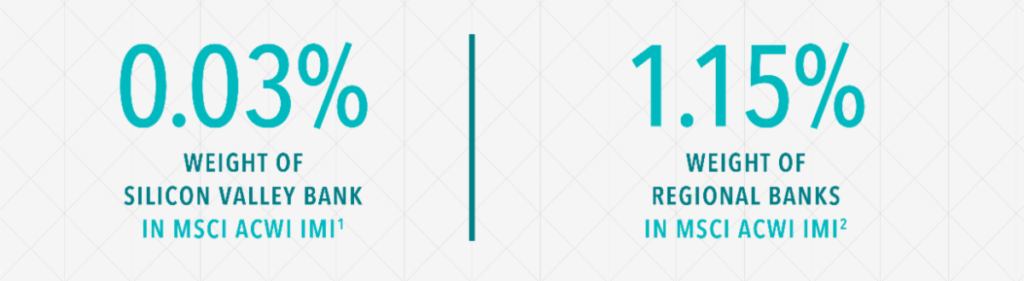
Global diversification may not make headlines, but it shows that exposure to one name, one area is extremely limited.
You and Your Money
During times of heightened risk, the longing to take hurried action becomes a pull that’s often too strong to overcome on your own. Media headlines and market volatility can make us question our long term strategies. Just a reminder that we need to “block out this noise” and times like this can potentially create opportunities.
Call us at 402-371-1160 with any questions as we walk through this together.
1The MSCI All Country World IMI Index is a broad market-capitalization-weighted index of public companies across developed and emerging markets globally. As of February 28, 2023, the MSCI All Country World IMI Index included 9,010 companies. MSCI data © 2023, all rights reserved. Silicon Valley Bank weight represented by its parent company SVB Financial Group.
2Regional banks weight reflects the weight of the “Regional Banks” GICS Sub-Industry as of February 28, 2023, as defined prior to March 17, 2023. GICS was developed by and is the exclusive property of MSCI and S&P Dow Jones Indices LLC, a division of S&P Global.
Dimensional Fund Advisors LP is an investment advisor registered with the Securities and Exchange Commission. All expressions of opinion are subject to change. This information is not meant to constitute investment advice, a recommendation of any securities product or investment strategy (including account type), or an offer of any services or products for sale, nor is it intended to provide a sufficient basis on which to make an investment decision. Investors should consult with a financial professional regarding their individual circumstances before making investment decisions.
Elements taken from Wendy Cook and Disclosures, Copyright © 2023, Wendy J. Cook Communications, LLC.