Dimensional Fund Advisors Vice President, Apollo Lupescu, PhD and Jared Faltys, CPA/PFS provide a current market update. Recorded October 16, 2025.
Category: Blog
Modernizing Payments for Individual Taxpayers
Paper Checks Phasing Out:
Executive Order 14247, “Modernizing Payments To and From America’s Bank Account”, was signed on March 25th, 2025. This policy is working to transition payments made to and from the U.S. Department of Treasury to be fully electronic. Beginning September 30th, 2025, the federal government ceased issuing paper checks, with limited exceptions.
The Goal of This Policy Change:
Safety and Security: Electronic payments can help reduce the risk of fraud, theft, and undeliverable mail. According to the irs.gov, “paper checks are over 16 times more likely to be lost, stolen, altered, or delayed than electronic payments.”
Efficiency and Reduced Costs: Paper refund checks can take 6 weeks or more to arrive by mail. Electronic refunds may be issued in half that time or less with direct deposit. In addition to electronic payments being a more efficient option, it also costs less than paper checks.
Information for Individual Taxpayers:
No Changes to Filing: Taxpayers should expect to file the same. To avoid issues or delays, ensure that your bank account information is included and accurate when filing.
Payments and Refunds: The majority of refunds will be delivered via direct deposit. For payments made to the federal government, it is not yet mandated to do so electronically, but it is recommended that you start making payments electronically as well.
The policy does allow for certain expectations for those without access to bank accounts. If you have any questions about electronic payments or refunds, please do not hesitate to reach out to us.
Webinar: Nebraska’s New Sick Leave Policy
Clint Weeder from McMill CPAs & Advisors, and Jordan Arndt from Zelle HR, discuss the new Nebraska sick leave policy details, share implementation tips and go through numerous FAQs. Recorded September 18th, 2025.
The information presented in this webinar is provided for educational and informational purposes only. It should not be considered legal, tax, or accounting advice. You should consult with your CPA, attorney, or other qualified professional regarding questions specific to your situation.
Lemonade Camp – August 5th, 2025
Norfolk’s annual Lemonade Camp, hosted by McMill CPAs & Advisors, Retirement Plan Consultants and Wealth Management, was a success again in 2025! Lemonade Camp has been held annually since 2011. The camp invites kids to come learn business basics and apply those lessons to their own business, a lemonade stand! All money raised at Lemonade Camp is always donated back to the community.
Tuesday, August 5th, 2025, over 75 young entrepreneurs gathered to spend the day learning business skills, running their own lemonade stand and having fun! The campers raised over $650 to be donated to the Norfolk Fire Department’s Junior Fire Fund. 🚒🍋
Wealth Management Fall Newsletter 2025

TIMELESS WISDOM FROM WARREN BUFFETT
In May, legendary investor Warren Buffett announced he will retire as CEO of Berkshire Hathaway at the age of 95. Sixty years ago, Buffett took over Berkshire Hathaway, a struggling New England textile company, and built it into a powerhouse that operates everything from insurance companies to household brands like Duracell batteries. Along the way, he became known as the “Oracle of Omaha” due to his reputation for carefully identifying undervalued companies and sticking with them for the long haul. It’s a strategy that has served him well. Today, he is the sixth richest person in the world with a net worth of about $154 billion.
Throughout his career, Buffett has shared some of the secrets to his success, often through his famed—and frequently funny—shareholder letters. Below are some of our favorite insights that continue to guide investors of all kinds.
Navigating Fear and Greed
“Occasional outbreaks of those two super-contagious diseases, fear and greed, will forever occur in the investment community…We never try to anticipate the arrival or departure of either disease. Our goal is more modest: we simply attempt to be fearful when others are greedy and to be greedy only when others are fearful.”
Investing is carried out by people, and people are emotional. As a result, human behavior plays a huge role in the movements of markets. The powerful impulses toward fear and greed can lead investors to hop in and out of the market en masse, often to their detriment. Buffett warns us to be wary when investors are “greedy,” as they can push prices up—sometimes unsustainably—leading to a crash. Similarly, when investors are fearful, they may miss out on powerful opportunities to invest in bargains during a market downturn.
The key to good investing is controlling emotional urges. Buffett has said: “The most important quality for an investor is temperament, not intellect. You need a temperament that neither derives great pleasure from being with the crowd or against the crowd.”
Bursting Bubbles
“Bubbles blown large enough inevitably pop. And then the old proverb is confirmed once again: ‘What the wise man does in the beginning, the fool does in the end.’”
During market bubbles—like the Dot Com bubble of the late 1990s or the housing boom that preceded the 2008 crash—prices rise rapidly beyond their true value driven by speculation and hype. Even investors who were initially skeptical might succumb to the urge to jump on the bandwagon, entering the market when prices are overly inflated and due for a crash.
Buffett has also said, “It’s only when the tide goes out that you learn who’s been swimming naked.” Indeed, when a booming market reverses course, you don’t want to be the one who has taken on too much risk and is left scrambling for your clothes.
Playing the Long Game
You’ve probably heard us say investing is a long-term venture. This happens to be one of Buffett’s fundamental tenets as well. To wit: “Our favorite holding period is forever.” He has also said, “Only buy something that you’d be perfectly happy to hold if the market shut down for 10 years.”
The evidence is clear: Over the long term, the stock market has historically moved higher. Committing to long-term holding periods is the best way to ride out the inevitable short-term market fluctuations that come with the historical upward trend.
Starting Early
“Someone’s sitting in the shade today because someone planted a tree a long time ago.”
Unsurprisingly, there is a lot of overlap in aphorisms about planting trees and investing. Both require planning and an early start to ensure you reap their benefits. Likewise, a well-built investment plan requires attention and nurturing, which we can make easier through disciplined approaches like dollar-cost averaging—the practice of regularly investing a set amount of money no matter market conditions—and periodic rebalancing. But mostly, wealth and trees just need time to grow.
In that sense, Buffett’s “secrets” of success have never really been secrets. They are just simple truths that all investors can follow: stay calm when others panic, resist the hype, invest regularly and think long term. But even with these insights, it’s not always easy to stay the course—especially when markets get turbulent. Please reach out when you have questions about the markets and how they affect your long-term plan.
THE POWER OF PURPOSE IN RETIREMENT
If you’re lucky, summer has been a chance to unwind, catch up on beach reads and spend quality time with family and friends before the familiar rhythm of fall resumes. But what happens when there’s no routine to return to? For many, that’s the dream of retirement: endless relaxation, free from the constraints of work. But the reality can be more complicated.
Retirement is a major life shift, one that impacts more than just your schedule. It can reshape your sense of identity, daily habits and even your health. In fact, research has shown that retirement can raise the risk of heart disease and other medical issues by up to 40%. The reason? Experts point to a loss of purpose and reduced social connection, both of which can take a toll on mental and physical well-being. Without a plan for how to spend your time meaningfully, the transition can bring unexpected emotional challenges.
The Risks of Unstructured Retirement
Many retirees begin this new chapter with a “honeymoon phase”—a period marked by the novelty of free time, relaxation or long-awaited travel plans. But this initial high can eventually fade. When the excitement of sleeping in and checking items off the bucket list wears off, retirees can find themselves facing unexpected emotional challenges. Common struggles include boredom, loss of routine, identity shifts and social isolation. In fact, 24% of older adults are considered to be socially isolated. Isolation can also have a ripple effect on health: It’s associated with a 50% increase in risk of developing dementia and increased risk of premature mortality.
Designing a Retirement with Purpose
To avoid some of the potential pitfalls of an unstructured retirement, it’s important to think carefully—and proactively—about purpose. What do you want this next phase of life to look and feel like? Beyond financial planning, consider how you’ll meet the deeper needs that your pre-retirement life—including work and raising kids—may have fulfilled: structure, identity, accomplishment, social connection and a sense of meaning. What brings you pleasure and meaning? What have you always wanted to try or learn? Pursuing these activities can provide purpose and help ensure retirement is not just a long vacation, but a rewarding chapter of your life. Feeling stuck here? Try asking close friends or family what they see light you up. Often, others can reflect back passions or strengths that are hard to see on your own.
Staying Connected and Active
Relationships and physical routines matter more than ever when you retire. Staying active, both physically and socially, offers measurable health benefits. Regular physical activity lowers risks, including the likelihood of dementia, heart disease, stroke and eight types of cancer. People-centered activity is important, too. Look for ways to stay engaged, whether through volunteering, mentoring, part-time work, creative pursuits or community involvement. Older volunteers, aged 55 and up, who gave 100 hours or more each year were two-thirds less likely to report poor health than non-volunteers.
Spending more time with family is a high priority for many retirees and can be a great way to fulfill social needs. But make sure that vision is shared. Open conversations with loved ones about time together, expectations and boundaries can help align plans and avoid disappointment down the road.
The Retirement Identity Shift
In many ways, it’s hard to define what retirement is. After all, it’s not a single moment but a series of transitions. For instance, rather than an abrupt shift to not working at all, you may consider bridge employment—usually part-time work in a temporary position or as a consultant in your field or in a different industry. This can offer a gradual shift into retirement, providing continued income and engagement as you adjust. As your vision for retirement evolves, keep us in the loop. We’d love to hear what you’re planning—and we’re here to help ensure your financial strategy stays aligned with your goals.
DONUT BUY THE MEME HYPE
Lately, investors may be having flashbacks to the early days of meme investing. Newly labeled meme stocks like Krispy Kreme (DNUT) have joined the meme menu with members of the original stack, including GameStop (GME) and AMC Entertainment (AMC).
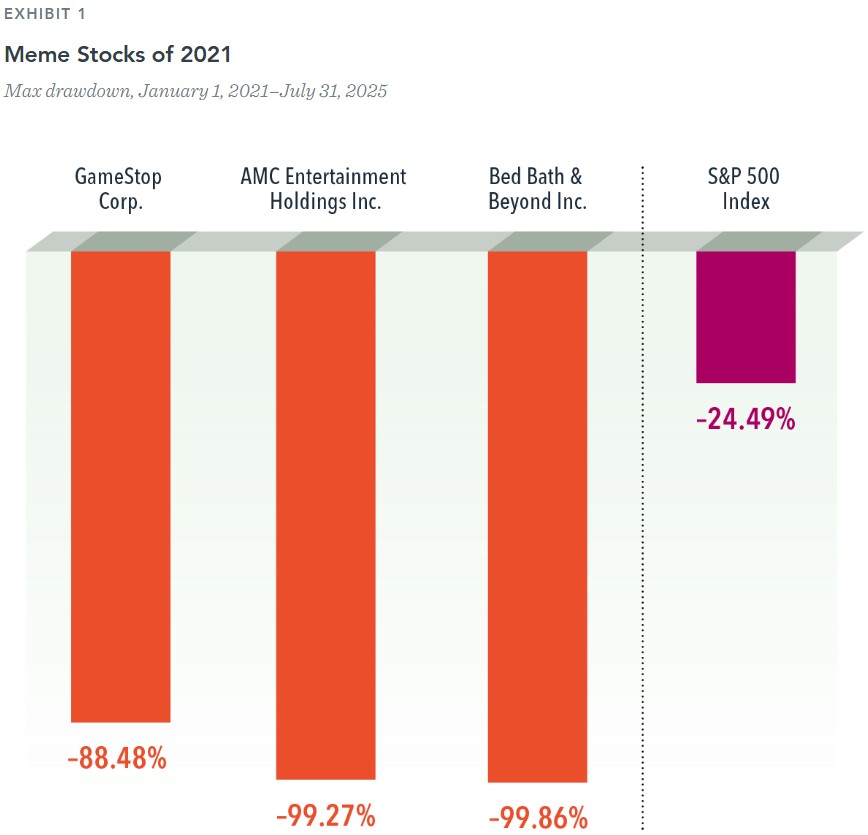
But before investors consider loading up their portfolios with DNUT or any other meme stock, remember that chasing them is just another form of stock picking and market timing. History suggests such tactics rarely pay off: Those who try to pick winners generally lose to the broad market.
Single stocks—meme or otherwise—have a wide range of returns and on average underperform the broad market. Examining how meme stocks have fared since the phenomenon began can provide a reminder to investors to take caution. Many meme stocks have experienced extreme volatility: GME, for example, saw eye-wateringly high returns in early 2021 before falling sharply. Some, like Bed, Bath, and Beyond (BBBY), don’t even exist anymore.
By holding a diversified portfolio, investors often get exposure to meme stocks, while being more likely to capture market returns and limit individual stock risk. Stocking up on just one thing—whether it’s donuts or stocks with buzzy appeal—is not a reliable strategy for long-term satisfaction. But a well-balanced portfolio will often include a few meme stocks, which, like donuts, are best enjoyed in moderation.
Past performance is not a guarantee of future results.
Indices are not available for direct investment; therefore, their performance does not reflect the expenses associated with the management of an actual portfolio. In USD. Source: Dimensional, using FactSet data. Drawdowns are the cumulative negative returns from the prior peak. Peak is defined as the highest cumulative return level prior to a given day. This information should not be considered a recommendation to buy or sell a particular security. Named securities may be held in accounts managed by Dimensional. It should not be assumed that an investment in the securities identified was or would be profitable. S&P data © 2025 S&P Dow Jones Indices LLC, a division of S&P Global. All rights reserved.
This article originally appeared in Above the Fray, a weekly newsletter for Dimensional clients.
Please see end of this post for important disclosures.


IN SUMMARY
Last quarter we referred to Warren Buffett deciding to step down from his current position with Berkshire Hathaway. In this issue, we wanted to share once more a few of his investment strategy ideas.
With the volatility in the market that we have been experiencing, more people have been questioning investing in gold. Gold does not provide the stability that many people think that it does. Warren Buffett does not favor investing in gold, saying that it just lies there and does not produce anything. Bitcoin has also been in the news and talked much about lately. It is very speculative in nature, and does not provide a source for long-term investment. If you have extra money that you are not afraid to lose and want to gamble or speculate with, then bitcoin might be an answer to that.
The resurgence of meme stocks such as Krispy Kreme, GameStop, and AMC highlights their volatility and tendency to underperform the broader market. A diversified portfolio offers broader market exposure and stability, with meme stocks best enjoyed in moderation rather than as the core of an investment strategy.
Planning for your retirement should probably include more than just the dollars and cents needed. It has been proven that we need a “purpose” to get up in the morning, including when you are retired.
There is a lot of noise out there in the news. Try not to let it influence your views and decisions when it comes to investing. If you have any questions or concerns, please contact us. Wishing you and your family a great fall season!
Disclosures for Donut Buy the Meme Hype
dimensional.com
Dimensional Fund Advisors | Aug 13, 2025
Written By: Isabelle Williams | Deputy Head of Investment Solutions
The information in this material is intended for the recipient’s background information and use only. It is provided in good faith and without any warranty or representation as to accuracy or completeness. Information and opinions presented in this material have been obtained or derived from sources believed by Dimensional to be reliable, and Dimensional has reasonable grounds to believe that all factual information herein is true as at the date of this material. It does not constitute investment advice, a recommendation, or an offer of any services or products for sale and is not intended to provide a sufficient basis on which to make an investment decision. Before acting on any information in this document, you should consider whether it is appropriate for your particular circumstances and, if appropriate, seek professional advice. It is the responsibility of any persons wishing to make a purchase to inform themselves of and observe all applicable laws and regulations. Unauthorized reproduction or transmission of this material is strictly prohibited. Dimensional accepts no responsibility for loss arising from the use of the information contained herein.
This material is not directed at any person in any jurisdiction where the availability of this material is prohibited or would subject Dimensional or its products or services to any registration, licensing, or other such legal requirements within the jurisdiction.
“Dimensional” refers to the Dimensional separate but affiliated entities generally, rather than to one particular entity. These entities are Dimensional Fund Advisors LP, Dimensional Fund Advisors Ltd., Dimensional Ireland Limited, DFA Australia Limited, Dimensional Fund Advisors Canada ULC, Dimensional Fund Advisors Pte. Ltd., Dimensional Japan Ltd., and Dimensional Hong Kong Limited. Dimensional Hong Kong Limited is licensed by the Securities and Futures Commission to conduct Type 1 (dealing in securities) regulated activities only and does not provide asset management services.
RISKS
Investments involve risks. The investment return and principal value of an investment may fluctuate so that an investor’s shares, when redeemed, may be worth more or less than their original value. Past performance is not a guarantee of future results. There is no guarantee strategies will be successful.
UNITED STATES
Dimensional Fund Advisors LP is an investment advisor registered with the Securities and Exchange Commission.
Investment products: • Not FDIC Insured • Not Bank Guaranteed • May Lose Value
Dimensional Fund Advisors does not have any bank affiliates.
Investments provided through McMill Wealth Inc, a Nebraska Corporation, Registered Investment Advisor
This material is derived from sources believed to be reliable, but its accuracy and the opinions based thereon are not assured.
The articles and opinions in this publication are for general information only and are not intended to serve as specific financial, accounting or tax advice
Paid Sick Leave – Effective 10/01/2025
The Nebraska Healthy Families and Workplaces Act (HFWA) takes effect on October 1, 2025. A key component of the act is Initiative 436, which requires employers to provide paid sick time based on the number of employees:
- The HFWA does not apply to businesses with less than 11 employees.
- Businesses with 11-19 employees, including full-time, part-time or temporary employees, must provide 40 hours per year of paid sick leave.
- Businesses with 20 or more employees must provide 56 hours per year of paid sick leave.
- These are minimum requirements and an employer may choose to provide additional paid sick leave.
If a business already has a current PTO policy or sick leave policy in place, and it meets the minimum requirements of the act, they are not required to offer additional sick leave time. Employers are encouraged to discuss their current policy with a legal advisor if they have any questions or concerns. The FAQs available on the DOL website provide additional guidance on this act.
When determining business size:
- The DOL includes employees who worked at least 80 hours in the state of Nebraska in a calendar year.
- Scenario: An employer that normally has 8 employees on payroll, has 4 turnovers and 4 new hires in a calendar year, so therefore issues 12 W2s. This employer would not be subject to this act because the employer never had 11 or more concurrent employees.
Nebraska Employer Action:
- Written notice is required to be provided to all current employees by September 15, 2025, and to all new employees going forward. The DOL has provided a model notice you can use to satisfy this requirement, or you may produce your own written notice.
- The NE DOL poster must be displayed if there is a physical worksite. If there is no physical workplace, electronic communications can satisfy this requirement.
- If 5% or more of the employees do not speak English as a first language, and the DOL has translated versions available, the employer must provide the notice and poster in that language as well. The DOL currently has provided a notice and poster in Spanish.
Each pay period, whether on the physical paystub, as an attachment, or via an online platform, the amount of paid sick time available, amount of paid sick time taken, and amount of pay the employee has received as paid sick time must be provided to each employee.
As a reminder, although the act doesn’t take effect until October 1, 2025, written notice to employees regarding this act must be provided to employees by September 15, 2025. We anticipate additional guidance will come from the NE DOL as this act takes effect. We will do our best to provide timely updates. If you have any questions, please don’t hesitate to reach out.
Understanding the New Trump Accounts
With the enactment of the One Big Beautiful Bill Act in July 2025, Congress introduced a new class of tax-advantaged savings vehicles for minors known as Trump accounts. Here’s a breakdown of the key features.
What are they?
Trump accounts are custodial savings and investment accounts that can be established for U.S. children under age 18 to encourage long-term financial security. Contributions are made on an after-tax basis, and investments grow tax deferred until withdrawn. Withdrawals are generally prohibited until the year the child reaches age 18. These accounts are specifically targeted toward children.
Who is eligible?
Beginning July 2026, Trump accounts can be established for children who are U.S. citizens, have a valid Social Security number, and are under age 18. In addition, the new law creates a pilot program in which qualified account holders born between January 1, 2025, and December 31, 2028, are eligible for a one-time government contribution of $1,000. The Department of the Treasury may automatically enroll these children into the program. Children born outside of the 2025–2028 window, but who are still under age 18, qualify for a Trump account, though they will not receive the $1,000 seed grant. Trump accounts do not have income limits or restrictions.
What are the contribution limits?
Parents, relatives, and others may contribute up to $5,000 per child annually. The $5,000 cap will be adjusted for inflation in future years. Contributions are made with after-tax dollars.
Employers are able to set up plans under which contributions may be made to employees’ Trump accounts or the Trump accounts of employees’ dependents. Up to $2,500 may be contributed annually for each employee. Contributions made by an employer to a Trump account on behalf of an employee under such a plan are not included in the employee’s gross income.
Charities and governmental entities may also make contributions to Trump accounts under certain conditions. Any such contributions by charities and governmental entities do not count toward the $5,000 annual limit. Also, the $1,000 federal seed contribution is excluded from the $5,000 annual contribution limit.
What is the tax treatment for these accounts?
Contributions from individuals are made with after-tax dollars, meaning they are not deductible but will eventually be able to be withdrawn tax-free. Employer, charitable, and government contributions, as well as the $1,000 seed grant, are not considered income at the time the contribution is made but will be included in income upon distribution.
Earnings on all contributions grow tax deferred. When the account holder reaches age 18 and is able to take distributions, the account may contain amounts that are not taxable upon distribution (amounts contributed by parents and relatives) as well as amounts that are taxable upon distribution (earnings, and any contributions made by an employer, charitable or governmental entity, or as a result of the $1,000 seed grant). The same general rules that apply to IRAs apply to Trump accounts, including:
- If there are non-taxable parent or individual contributions in the account, any distribution is considered to consist of a proportionate share of taxable and non-taxable amounts.
- Taxable distributions are taxed at ordinary income rates, and a 10% additional penalty tax applies if a distribution is made prior to age 59½ unless an exception applies.
- Exceptions to the 10% penalty include withdrawals for higher education costs and up to $10,000 for a first-time home purchase.
How are the funds invested?
Trump account funds are automatically invested in a mutual fund or exchange-traded fund that tracks the returns of a qualified index, such as one tracking the S&P 500. Account holders cannot choose between multiple funds or adjust the investment mix, and the allocation is fixed and limited to U.S. equities. Funds must have annual fees no higher than 0.1%.
What’s next?
The IRS is expected to issue additional regulations and guidance that clarify the administrative details of the new law.
All investing involves risk, including the possible loss of principal, and there is no guarantee that any investment strategy will be successful.
Mutual funds and exchange-traded funds are sold by prospectus. Consider the investment objectives, risks, charges, and expenses carefully before investing. The prospectus, which contains this and other information about the investment company, can be obtained from your financial professional.
The performance of an unmanaged index is not indicative of the performance of any specific security. Individuals cannot invest directly in any index. Past performance is no guarantee of future results. Actual results will vary.
With tax-deferred growth, federal government seeding, and flexible options for using funds, Trump accounts can serve as a new way to invest in the next generation.
IMPORTANT DISCLOSURES
Broadridge Investor Communication Solutions, Inc. does not provide investment, tax, legal, or retirement advice or recommendations. The information presented here is not specific to any individual’s personal circumstances.
To the extent that this material concerns tax matters, it is not intended or written to be used, and cannot be used, by a taxpayer for the purpose of avoiding penalties that may be imposed by law. Each taxpayer should seek independent advice from a tax professional based on his or her individual circumstances.
These materials are provided for general information and educational purposes based upon publicly available information from sources believed to be reliable — we cannot assure the accuracy or completeness of these materials. The information in these materials may change at any time and without notice.
This communication is strictly intended for individuals residing in the state(s) of NE. No offers may be made or accepted from any resident outside the specific states referenced.
Prepared by Broadridge Advisor Solutions Copyright 2025.
ONE BIG BEAUTIFUL BILL ACT (OBBBA) – KEY TAX TAKEAWAYS
On July 4th, 2025, the One Big Beautiful Bill Act (OBBBA) was signed into law by President Trump. This bill introduces new provisions and also extends or makes permanent several of the provisions that were part of the Tax Cuts and Jobs Act of 2017 (TCJA). The TCJA was passed during President Trump’s first term and many of the provisions of that Act were scheduled to expire in 2025.
There are various tax changes resulting from the recent passing of the OBBBA. We wanted to highlight a few that we feel would be most likely to affect our clients.
Below is a summary of some of the key tax changes that may impact individuals and businesses.
Individual Tax Updates:
- No Tax on Tips: This provision is in effect from 2025-2028. Qualified workers may deduct up to $25,000 of tip income.
- No Tax on Overtime: Effective 2025-2028, up to $12,500 ($25,000 for joint filers) of overtime wages are deductible.
- Tax Rates Remain Unchanged: The OBBBA makes the seven standard tax rates permanent from the 2017 TCJA. (10%, 12%, 22%, 24%, 32%, 35%, and 37%)
- Standard Deduction: In 2017, the standard deductions were doubled. The Act makes those changes permanent and increases standard deductions to $15,750 for single filers and $31,500 for joint filers for 2025.
- Personal Exemptions: Makes the elimination of personal exemptions permanent.
- Mortgage Interest Deduction: The limit for mortgage interest deductions is permanently capped at $750,000 of mortgage debt. The limit previously was $1 million of debt.
- Child Tax Credit: The child tax credit will permanently increase to $2,200, up from $2,000 previously.
- Senior Tax Deduction: Those 65 and older will receive a bonus deduction of $6,000, $12,000 for married couples filing jointly. This phases out for single taxpayers whose income is $75,000 or more, or $150,000 or more for married taxpayers.
- State and Local Tax Deduction: This deduction increased to $40,000 through 2029. In 2030, the State and Local Tax deduction will revert to $10,000.
- Car Loan Interest Deduction: From 2025-2028, deduct up to $10,000 in interest on a loan for an automobile that is assembled in the USA. This phases out for single filers with a modified AGI over $100,000 and joint filers over $200,000.
- Trump Accounts: New, tax-advantaged savings accounts that may be opened for children under 18 years old. Can contribute up to $5,000 per account per year. For US citizens born between 2025-2028, the federal government will make a one-time $1,000 contribution per child.
- Green Energy Policies: Many of the clean energy tax incentives from the 2022 Inflation Reduction Act will be terminated. This includes terminating the residential clean energy tax credit as well as the energy efficient home credit.
- Estate and Gift Tax Exemptions: The lifetime gift and estate tax exemption permanently increased to $15 million per person, or $30 million for married couples. This will be indexed for inflation in the future.
- Charitable Contributions: For individuals who do not itemize, an above-the-line deduction of up to $1,000 for single filers or $2,000 for joint filers is allowed for charitable contributions.
Business Tax Updates:
- Bonus Depreciation: The Act reinstates and makes permanent the 100% first-year bonus depreciation for property that was acquired after January 19, 2025.
- Section 179 Increase: The maximum amount a taxpayer may expense is increased to $2.5 million under the Act, (increased from $1.25 million).
- Domestic Research and Experimental Expenditures: Restores businesses ability to deduct domestic research or experimental expenditures paid or incurred beginning in 2025. Businesses with less than $30 million in revenue may elect to apply this retroactively back to January 1, 2022.
- Qualified Business Income: The OBBBA makes the Section 199A deduction permanent.
- 1099 Reporting Threshold Increase: Starting in 2026, the threshold for reporting income on a Form 1099 will increase from $600 to $2,000.
- Opportunity Zones: The OBBBA permanently extends and makes modifications to the Opportunity Zone program, a program which offers tax incentives for investments made in qualified low-income communities.
The summarized list above is only an overview of a fraction of the changes implemented in the OBBBA. The full OBBBA text can be viewed online. We will continue to monitor legislative updates. Please don’t hesitate to contact us if you have any questions regarding these changes or how it may affect you or your business.
WEBINAR (7/10/25) – NAVIGATING THE MARKETS – 2ND QUARTER SUMMARY
Dimensional Fund Advisors Vice President, Apollo Lupescu, PhD and Jared Faltys, CPA/PFS provide a current market update. Recorded July 10, 2025.
Wealth Management Summer Newsletter 2025

HOW CAN I GIVE MY KIDS A HEAD START ON INVESTING?
The earlier you start investing, the better. You’ve heard this advice before, and hopefully it’s helped you make some smart financial moves. But there’s one group that may not yet know this bit of investing wisdom: the kids in your life. Whether you have kids, grandkids, or nieces and nephews, these youngsters have an enormous asset on their side: time. Helping them get an early start with investing can give them a huge financial boost. The good news is that there are a lot of ways you can help set up the next generation for financial success. Let’s explore some options.
529 PLANS: A GREAT TOOL FOR FUTURE EDUCATION COSTS
With rising education costs, 529 plans are often the first type of investment account that parents open for their children. It makes sense. They’re one of the best tools available for long-term education savings.
You probably already know the main benefits: tax-deferred investment growth, tax-free withdrawals for qualified education expenses and no federal contribution limits (though gift tax may apply beyond annual contributions of $19,000 for 2025). Friends and family can contribute, and funds can be used for a growing range of expenses: college, of course, but also up to $10,000 per year for K–12 tuition. And excess funds can be rolled over to another family member, used to pay for grad school or even used to pay off student loans.
CUSTODIAL ACCOUNTS: MORE FLEXIBILITY BUT LESS CONTROL
But what if you want to help your child invest toward future expenses not covered by a 529 plan, like car repairs, travel or the down payment on a house? That’s where custodial accounts might be appropriate. UGMA (Uniform Gifts to Minors Act) and UTMA (Uniform Transfers to Minors Act) accounts are typically easier to set up than a trust and can accomplish some of the same goals.
Custodial accounts let you invest in a variety of assets in a child’s name, including stocks, bonds, mutual funds and even real estate. UTMA accounts also let you hold complex assets like art and intellectual property. There are no contribution limits, and the funds can be used for anything that benefits the child while they’re still a minor. However, your child takes complete control over the account when they reach adulthood (usually age 18–21, depending on the state). At that point, they can use the funds for any purpose. Note that investment earnings may be subject to the so-called kiddie tax. For 2025, that means the first $1,350 of unearned income is tax-free, the next $1,350 is taxed at the child’s marginal rate, and anything above that may be taxed at the parent’s marginal tax rate. Another word of caution: Custodial accounts are considered the child’s asset, which may impact financial aid eligibility more than a 529 plan would.
ROTH IRAS: EVEN KIDS CAN START SAVING FOR RETIREMENT
If you’re thinking even longer-term, you can help your kids start saving for retirement by opening a custodial Roth IRA on their behalf. Roth IRAs allow them to enjoy decades of tax-free investment growth and tax-free withdrawals in retirement.
To fund any IRA, the child must have earned income—such as from babysitting gigs or slinging ice cream over the summer. Those contributions cannot exceed their total earnings or the $7,000 annual limit (for 2025), whichever is lower. Then, once the child reaches adulthood (usually 18–21, depending on the state), they can transfer those savings to a new account to keep building a bright financial future.
BEYOND INVESTMENT BENEFITS: TEACHING FINANCIAL LITERACY
One of the best financial gifts you can give a child isn’t just money—it’s knowledge. And opening an investment account is an opportunity to introduce your family to some of the most important concepts in personal finance. You can start by talking to your kids about budgeting, saving and what it means to invest. Review account statements with them to highlight the power of compounding and the benefits of tax deferral. Use the target-date portfolios in a 529 plan to teach your kids about the value of diversification. And bring them into decisions when picking investments for a custodial account or Roth IRA. It’s a great chance to discuss the long-term advantages of choosing broader market exposure over trying to pick single stocks.
The earlier a child understands how money and investing works, the better their odds for achieving long-term financial goals. We’re here to help you give them that head start—whether it’s setting up accounts, discussing financial strategies or sharing more ideas for teaching kids about money.
LONGER HORIZONS LOOK BETTER FOR STOCKS
For many investors, it’s hard not to follow the daily fluctuations of the stock market. But day-to-day volatility is a reminder that stocks are best considered a long-term investment.
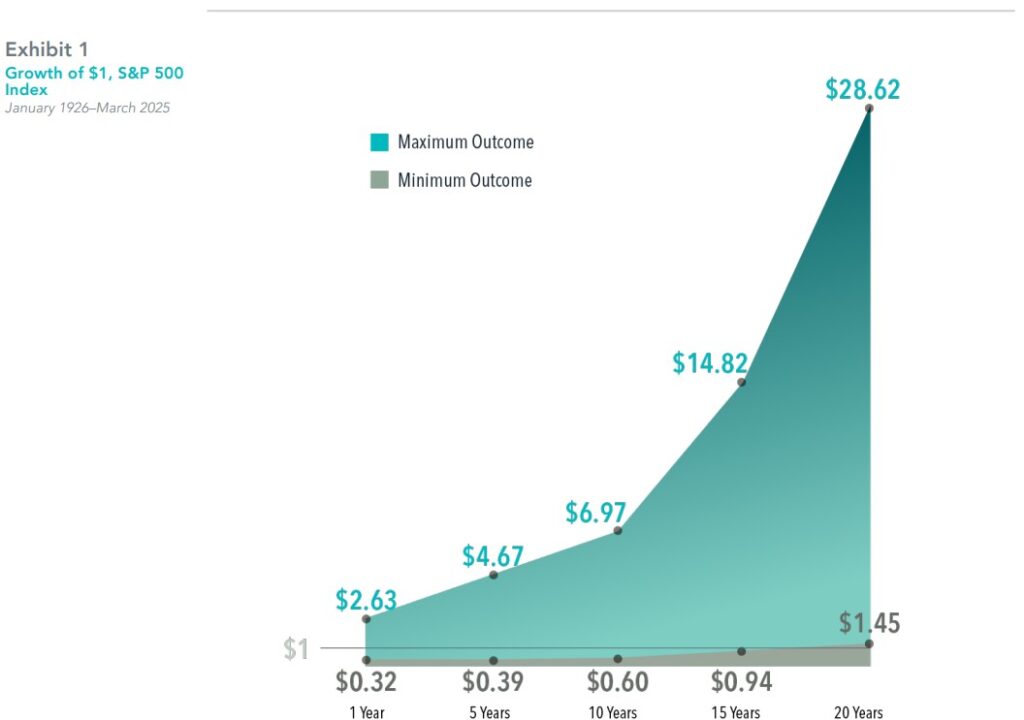
Part of the reason stocks have higher expected returns than bonds is uncertainty over shorter horizons. For example, the S&P 500 Index return was negative in about 24% of overlapping one-year periods from January 1926 through March 2025. The worst outcome over these one-year periods was about –68%, dropping $1 in invested capital to just $0.32.
Things have looked better over longer horizons, with the caveat that the number of independent observations among rolling return windows dwindles as the horizon lengthens—just five for the 20-year returns. But the frequency of negative returns decreases as the investment period expands, and no stretch over 184 months has been negative.
This is not to imply stocks are less risky in the long run. The range between best and worst outcomes becomes vast at the longer time horizons. But the data we have suggest the likelihood of losing money in stocks is far lower if they are viewed as long-term investments.
Of course, most investors also have short-term needs for their capital. That’s why most of us have a mix of stocks plus risk-management assets, such as bonds. A thoughtfully designed asset allocation helps balance short-term liabilities with long-term growth of wealth. And that’s a recipe for staying disciplined and paying less attention to the throes of stocks each day.
Past performance is no guarantee of future results.
Growth of $1 computed over rolling monthly periods for the S&P 500 Index assumes reinvestment of income and no transaction costs or taxes. Outcomes are reported for the minimum and maximum of these observations. There are 1,180 overlapping one-year periods, 1,132 overlapping five-year periods, 1,072 overlapping 10-year periods, 1,012 overlapping 15-year periods, and 952 overlapping 20-year periods. The analysis is for illustrative purposes only and is not indicative of any investment. S&P data © 2025 S&P Dow Jones Indices LLC, a division of S&P Global. All rights reserved. Indices are not available for direct investment.
This article originally appeared in Above the Fray, a weekly newsletter for Dimensional clients.
Please see end of this post for important disclosures.
IS GOLD A SAFE HAVEN?
Not since the release of the third Austin Powers movie have I heard so much talk about gold. Stellar recent returns account for some of that — gold was up 25% year-to-date as of April 30. But another reason is the belief among some market participants that gold represents a safe haven, an asset to stabilize the portfolio when equity markets are choppy.
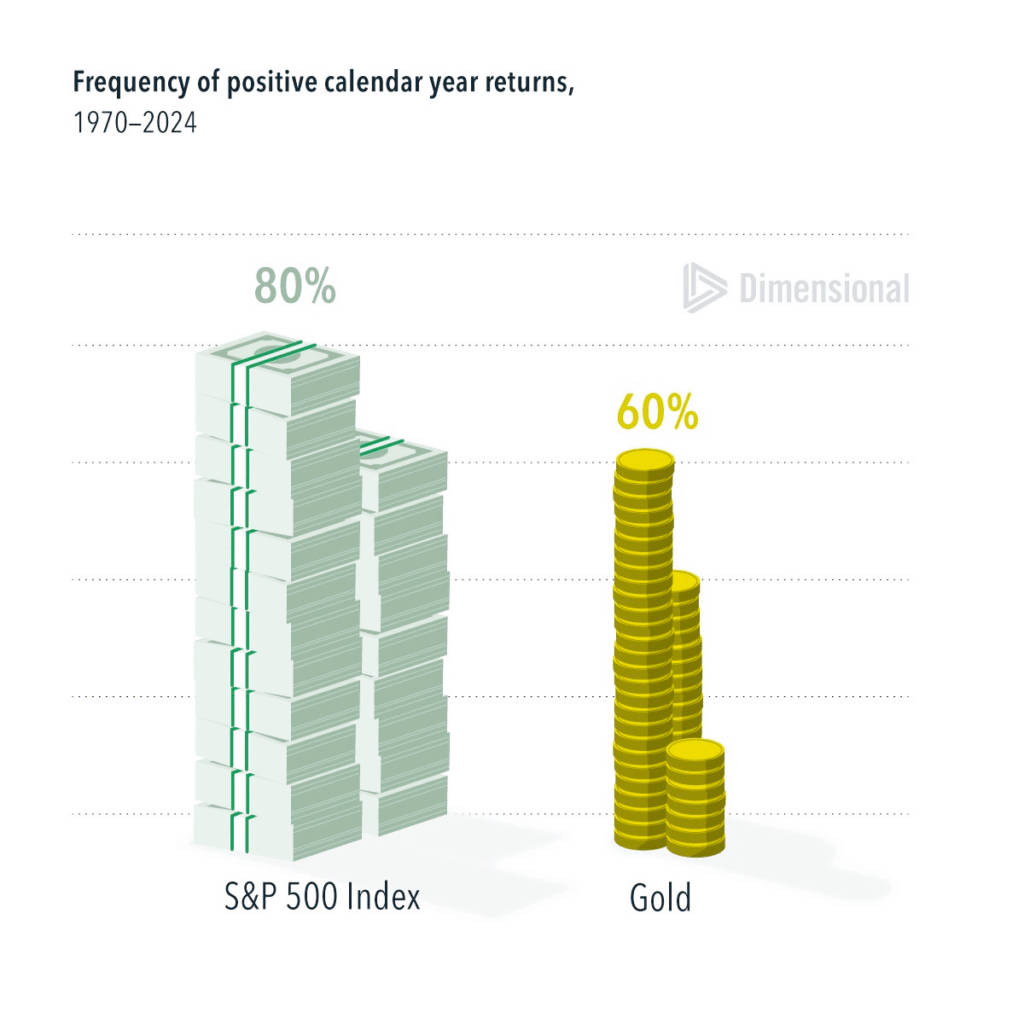
The problem with that story is gold has been far from immune to drawdowns. In fact, since 1970,
gold has been positive in just 60% of calendar years while the S&P 500 Index has been positive in 80%.
Investors hoping for a safe haven may not find it with gold.
Past performance is not a guarantee of future results.
In USD. S&P data © 2025 S&P Dow Jones Indices LLC, a division of S&P Global. All rights reserved. Gold source: Bloomberg returns from composite prices. Indices are not available for direct investment; therefore, their performance does not reflect the expenses associated with the management of an actual portfolio.
Please see end of this post for important disclosures.
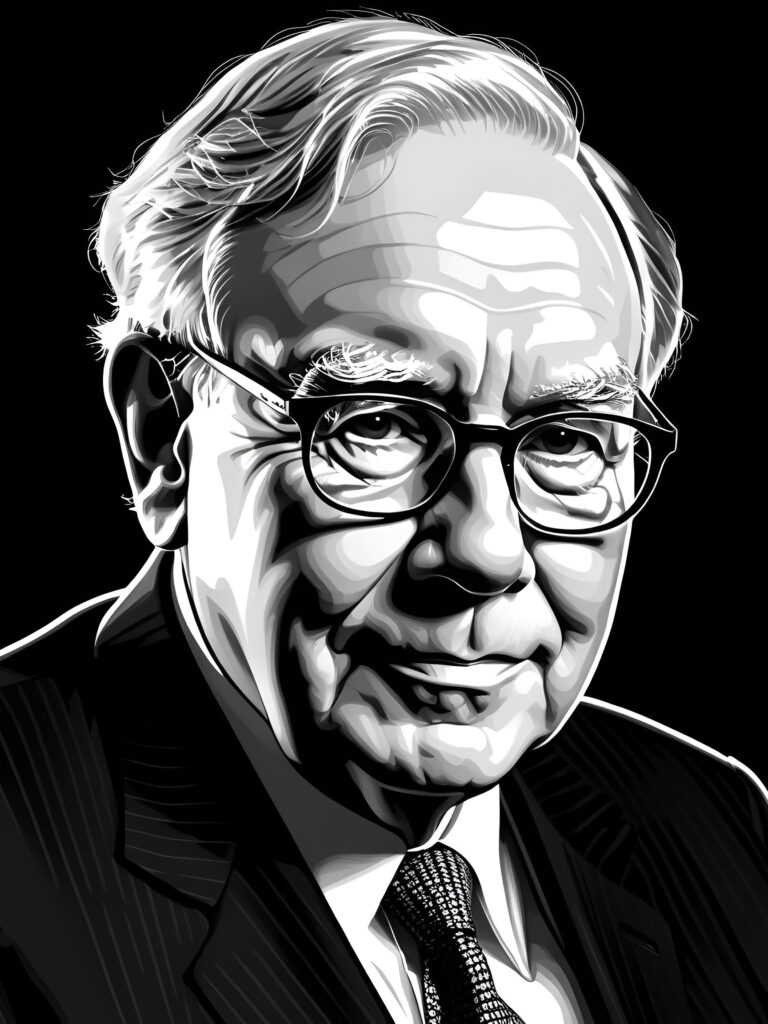

THE END OF AN ERA AND BEGINNING OF A NEW CHAPTER
Many made their annual voyage to Omaha, Nebraska for this year’s annual meeting for Berkshire Hathaway, which was held on May 3rd, 2025, to see and hear “the Oracle of Omaha” – Warren Buffett. This meeting marked an end of an era with Warren Buffett announcing that he would be stepping down at the end of 2025 as CEO of the company. He announced his recommendation of Greg Abel, Vice -Chairman of Non-Insurance Operations to succeed him as CEO of the company as of January 1, 2026. Buffett will remain as Chairman of the Board. The usual crowd-size for this event is somewhere around 40,000+ with people coming from around the world with many from China, again this year. Warren Buffett, who is 94 years old, ended the meeting after making his announcement of stepping down. With that, the crowd roared with applause, and rose to their feet to give Buffett a standing ovation. He laughingly responded by saying that their response to his announcement could be taken two ways.
It was also noteworthy this year that 2025 marked the 60th anniversary of Berkshire Hathaway which started in 1965. Honesty and integrity were virtues that Buffett tried to abide by in his management style of the company.
Many were there to latch on to some tidbit of information that they hoped could make them an automatic, overnight success at investing. Some were there to have just one more occasion to tap the knowledge and philosophies of Warren Buffett. His message is usually the same. That is, to not be easily influenced by the media when making investment decisions – stay rational. They often say that it is not how smart you are, but how able you are to control your emotional behavior that will determine how successful you are in investing. In responding to questions, he made several references to what Charlie Munger’s view might have been on many specific questions.
Volatility and uncertainty in the market seems to always be present, and no one knows what the future will hold. This is definitely true this year with all of the tariff negotiations that have been going on recently.
There is no way to predict how volatile the market will be in the future, but we are here to help when controlling your emotional behavior may not be an easy task. Contact us with your questions and any concerns, and enjoy your summer!
Disclosures for Longer Horizons Look Better for Stocks:
dimensional.com
Written By: Wes Crill, PhD, Senior Client Solutions Director and Vice President | Dimensional Fund Advisors – April 29, 2025
The information in this material is intended for the recipient’s background information and use only. It is provided in good faith and without any warranty or representation as to accuracy or completeness. Information and opinions presented in this material have been obtained or derived from sources believed by Dimensional to be reliable, and Dimensional has reasonable grounds to believe that all factual information herein is true as at the date of this material. It does not constitute investment advice, a recommendation, or an offer of any services or products for sale and is not intended to provide a sufficient basis on which to make an investment decision. Before acting on any information in this document, you should consider whether it is appropriate for your particular circumstances and, if appropriate, seek professional advice. It is the responsibility of any persons wishing to make a purchase to inform themselves of and observe all applicable laws and regulations. Unauthorized reproduction or transmission of this material is strictly prohibited. Dimensional accepts no responsibility for loss arising from the use of the information contained herein.
This material is not directed at any person in any jurisdiction where the availability of this material is prohibited or would subject Dimensional or its products or services to any registration, licensing, or other such legal requirements within the jurisdiction.
“Dimensional” refers to the Dimensional separate but affiliated entities generally, rather than to one particular entity. These entities are
Dimensional Fund Advisors LP, Dimensional Fund Advisors Ltd., Dimensional Ireland Limited, DFA Australia Limited, Dimensional Fund Advisors Canada ULC, Dimensional Fund Advisors Pte. Ltd., Dimensional Japan Ltd., and Dimensional Hong Kong Limited. Dimensional Hong Kong Limited is licensed by the Securities and Futures Commission to conduct Type 1 (dealing in securities) regulated activities only and does not provide asset management services.
RISKS
Investments involve risks. The investment return and principal value of an investment may fluctuate so that an investor’s shares, when redeemed, may be worth more or less than their original value. Past performance is not a guarantee of future results. There is no guarantee strategies will be successful.
UNITED STATES
Dimensional Fund Advisors LP is an investment advisor registered with the Securities and Exchange Commission.
Investment products: • Not FDIC Insured • Not Bank Guaranteed • May Lose Value
Dimensional Fund Advisors does not have any bank affiliates.
Disclosures for Is Gold a Safe Haven?:
dimensional.com
Written By: Wes Crill, PhD, Senior Client Solutions Director and Vice President | Dimensional Fund Advisors
Disclosures: All expressions of opinion are subject to change. This information is not meant to constitute investment advice, a recommendation of any securities product or investment strategy (including account type), or an offer of any services or products for sale, nor is it intended to provide a sufficient basis on which to make an investment decision. Investors should consult with a financial professional regarding their individual circumstances before making investment decisions. Diversification neither assures a profit nor guarantees against loss in a declining market.
Dimensional Fund Advisors LP is an investment advisor registered with the Securities and Exchange Commission.
Investment products: • Not FDIC Insured • Not Bank Guaranteed • May Lose Value
Dimensional Fund Advisors does not have any bank affiliates.
Investments provided through McMill Wealth Inc, a Nebraska Corporation, Registered Investment Advisor
This material is derived from sources believed to be reliable, but its accuracy and the opinions based thereon are not assured.
The articles and opinions in this publication are for general information only and are not intended to serve as specific financial, accounting or tax advice