
I received the PPP Funds… Now what?
– How should funds be used?
– What forgiveness looks like for businesses and sole proprietors?
– How do I stay organized with all the documentation needed for forgiveness and possible audit?
EIDL – Additional New Information
Stimulus Payments
Question and Answer session
Category: Uncategorized
WEBINAR – Investing In A Turbulent Market
Apollo D Lupescu, PhD, Vice President of Dimensional Fund Advisors, and Jared Faltys, CPA/PFS and Partner with McMill Wealth, review the history of the market.
Are you wondering what the current market means for your long-term investing goals?
Are you concerned about the constant news about market performance?
This webinar addresses your concerns and will use academic data, not fear, to talk about investing principals.
“Imagine you see a child playing with a yo-yo, riding up an escalator. Focus on the escalator, not the yo-yo.” -Mark Zinder
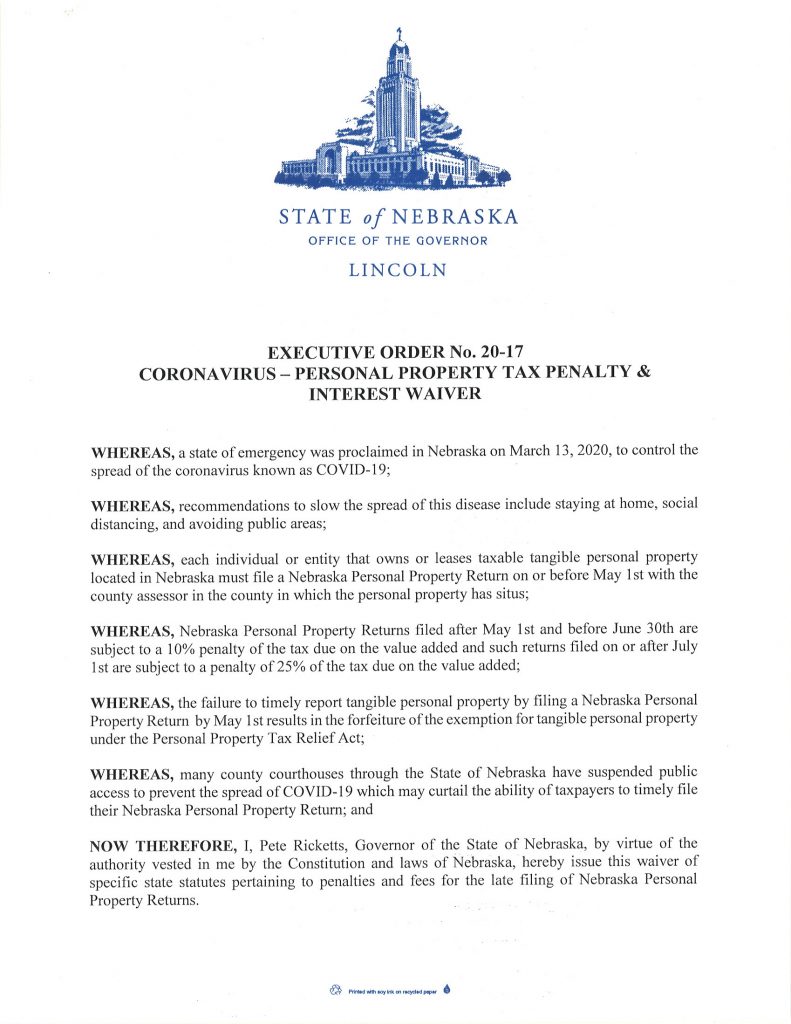
Nebraska Personal Property Tax Penalty & Interest Waiver
Personal property tax returns normally due May 1st have been extended to July 15th if you want to be allowed the $10,000 exemption.
Any returns filed after that time but by December 31, 2020 will forfeit the exemption but will not be assessed the late filing penalty.
Interest will start to accrue starting July 16th on any value added after July 15, 2020.
The exemption is still available if filed by July 15, 2020.

IRS Deadlines & PPP Additional Details
| IRS GRANTS ADDITIONAL RELIEF ON DUE DATES |
| The IRS just released Notice 2020-23 to extend more tax deadlines for individuals and businesses. The relief covers taxpayers that have a filing or payment deadline between April 1, 2020, and July 15, 2020. It applies to fiscal year entities, estate tax returns, nonprofit organizations, information returns, and more. In addition, the deadline for second quarter estimated tax payments has been moved from June 15 to July 15, and the relief is automatic so taxpayers don’t need to file any extension forms to get the relief. |
| PAYCHECK PROTECTION PROGRAM (PPP) WEBINAR |
| Thank you to everyone who was able to join us for the PPP Webinar. The webinar reviewed how the loan process works and the 8-week period for calculating loan forgiveness. Since the webinar was broadcast additional information was received, so we wanted to cover some details on the changes and reiterate some of the best practices we covered. When does the eight-week period begin? The eight-week period begins on the date the lender makes the first disbursement of the PPP loan proceeds to the borrower.The lender must make the first disbursement of the loan within ten calendar days from the date of loan approval (this is new information received after the webinar was recorded) Consider using a separate account dedicated to the PPP Loan proceeds. Using a separate account will make tracking much easier. If a copy of the bank activity is requested, you can easily provide detail on how the funds were used. Maintain detailed records for support of payroll costs. Prepare the data for submission related to each payroll including: Wages Group Health Care Coverage Health Care Costs Retirement Plan Employer Contributions If paying employees under the Families First Coronavirus Response Act for Emergency Sick Pay or Emergency FMLA, maintain adequate records as these amounts will be adjustments to your payroll costs.You cannot participate in the following CARES act benefits:Employee Retention CreditDelay of Employer Payroll Tax Payments (FICA)Keep a detailed record with invoices paid for the following: Rent – Utilities – Mortgage Interest Planning ahead will facilitate the maximum opportunity for Loan Forgiveness for the period of eight weeks after the date of your loan. Please use our calculator to estimate your loan forgiveness. Download The Calculator View The Webinar |
WEBINAR – The Paycheck Protection Program Loan
McMill CPAs & Advisors partnered with Midwest Bank to look at how the loan process works, and the 8-week period for calculating loan forgiveness. This loan is designed to assist businesses in retaining employees by providing cash flow for payroll and a few other specific expenses.
McMill CPAs & Adivsors and Midwest Bank will cover this program in detail.
– What specific expenses are covered (other than payroll)
– Loan Forgiveness Details
– Frequently Asked Questions – McMill CPAs & Advisors and Midwest Bank will review the questions they have received regarding the program
A loan forgiveness calculator can be found in our COVID-19 SBA Resource Center!
VIDEO CONTENT CLARIFICATION – The amount of forgiveness of a PPP loan depends on the borrower’s payroll costs over an eight-week period.
When does that eight-week period begin?
The eight-week period begins on the date the lender makes the first disbursement of the PPP loan to the borrower. The lender must make the first disbursement of the loan no later than ten calendar days from the date of loan approval.
Coronavirus: What to Do if You’re Out of Work
Coronavirus—aka COVID-19. It has flooded our social media, nightly news, and has even made its way into some of our communities. It goes without saying that this thing has created mass hysteria and panic across the globe. But if you’re looking for that here—you won’t find it.
We haven’t lost our hope, and you shouldn’t either. We’re going to get through this, folks. Emotions are running high surrounding the coronavirus, and it feels like there’s so much uncertainty. But you don’t need to live in fear.
Yes, this virus has impacted all of us, whether it’s by coming down with the sickness itself, becoming filled with anxiety from the news, or being out of work (and out of a paycheck). We’re all feeling it in some way. And with 78% of Americans living paycheck to paycheck,1 it’s easy to see why the loss of even just one paycheck could be devastating.
Will You Miss a Paycheck Due to the Coronavirus?
It’s no secret that things are shutting down all across the world. And if your workplace has closed its doors and isn’t offering pay, then it’s time for you to (calmly) regroup and get some things in order. The thought of being without a paycheck can be overwhelming. But we don’t want to scare you. We want to give you sensible, level-headed actions to take. But first, step back and take a big, deep breath.

Did you do it?
Okay, good.
Now let’s look at some things you can doto keep you on your feet—even without a paycheck.
7 Things to Do When You Miss a Paycheck
1. Get on a budget.
If you aren’t already living on a budget, the time is now! Making a monthly budget will show you exactly where your money is going—no ifs, ands or buts about it.
Without a budget, you really can’t make every dollar stretch because you might not even know how much money you have to work with. Plus, your budget will show you places where you can cut back and save money (more on that later). And you don’t have to rely on a yellow lined notebook to crunch the numbers. Give our free budgeting app, EveryDollar, a try and see how simple budgeting can be.
If you don’t have any income right now, then make a budget based on the amount of money you do have. If you have $600 left to your name, budget out exactly where each of those dollars will go. It’s time to squeeze every last penny out of what you’ve got.
If you still have cash coming in from your spouse’s job or some other source, then adjust your budget to reflect that. Maybe the two of you usually bring in a combined $5,000 a month. But with the loss of one income, you’re down to $2,500 a month.
Adjust your budget to live off of that one income for the time being. It might be tough to switch up your lifestyle, but you’ve got to make temporary sacrifices to get through this.
2. Take care of the Four Walls.
When the going gets rough—like it is right now—you need to focus on the things you really need to survive. We call these the Four Walls. Forget the student loan payment, the vet bill and the cell phone bill (for now). The Four Walls are your priority, so pay for these things in this order before anything else:
- Food
- Utilities
- Shelter
- Transportation
These are the basics you need to keep going so you can live to fight another day. And it’s really hard to fight when your family doesn’t have food, isn’t it? So if there’s no food in the fridge, don’t pay the cable bill.
If there’s any money left over after you take care of the Four Walls, make a list of what else you need to pay and tackle that in order of importance. When you run out of money—that’s it. Someone on the list isn’t getting paid, and that’s just how it goes. But it sure as heck isn’t going to be the checkout lady at the grocery store. Remember, that’s priority number one!
If you’re renting and having trouble coming up with cash right now, don’t stress out. Reach out to your landlord and be honest with them about what’s going on. They might be able to work something out with you for the time being, but they can’t help if they don’t know. Be up front with them and pray for the best.
3. Pause your debt snowball.
When you’re just trying to make it to another day, you don’t need to pay extra on your debt. Instead, focus on piling up cash as high as you can. This will help with peace of mind until you have income again. Once life gets back to normal and everything is okay, you can pick up where you left off with your debt snowball.
If you’ve been chipping away at your debt, you probably don’t want to see all your progress come to a screeching halt. But the reality is, if you’re not getting paid, then you’re in the middle of a crisis. So pause your debt snowball. If it’s within your budget to keep paying the minimum payments on your debt, go for it. But remember, the Four Walls come first. Don’t let your family go hungry for the sake of your FICO score.
4. Sell stuff.
Get radical. No, we don’t want you to go selling hand sanitizer on eBay for $50 a bottle. But this is the time to sell what you can to bring in extra cash. Maybe that’s your jewelry, clothes, baby items or even the extra car sitting in your garage. If you know you can part with something and get extra cash in your hands—do it! Well, within reason.
5. Get a temporary job or start a side hustle.
If you’re out of a paycheck because of the coronavirus (or your business is taking a serious hit from it), that’s a real thing. But you don’t need to freak about it—just go get some part-time work.
With so much being shut down right now, there might not be as many traditional ways to make extra money out there. Your local hotels, movie theaters and restaurants probably aren’t looking for help. So think about who might be hiring more right now. Look into driving for Amazon (hello, doorstep toilet paper deliveries), picking up takeout food for Postmates, or dropping off grocery orders with Shipt.
And even if one of those doesn’t work out, you can still take up odd jobs around your neighborhood (think cutting the grass, picking up leaves, babysitting, or dog walking). Be on the lookout for opportunities that will add a few extra bucks to your pocket. In this situation, every little bit helps.
6. Look for things to cut.
This is the time to cut back on any unnecessary expenses that you can. Tighten it up. Stop or pause your subscriptions (think Netflix, Hulu, meal delivery kits, specialty makeup boxes). They aren’t going anywhere, and you can easily pick them back up once everything blows over and you have extra cash to spend again.
Don’t forget to call your cable, internet and cellular providers to see if there’s anything they’ll do to work with you during this time. Be open and honest, and let them know your situation. You’ll never know if you don’t ask! And since you already have them on the line, go ahead and downgrade or pause your service for now. None of these things fall into the Four Walls, remember?
And have you heard of this thing called “social distancing?” It means people are encouraged (and want) to stay away from each other right now. Which can make it easier to not spend money. Sports venues are closed, Disneyland is closed—heck, even bars are closed. And even if places are open, this is a time when most people are staying home anyway. Your friends probably won’t pressure you to go hit the town this weekend. That’s good news for your budget.
We know making sacrifices like this can feel like adding insult to injury when you’re already hurting. But keep reminding yourself: This is not forever. We’re going to make it through this! You’re making temporary sacrifices to tread water until this storm passes and you’re back on your feet again.
7. Connect with your church or local community groups.
Let’s be clear here: Try to do everything in your power first before you seek help like this. Make sure you cut back where you can and take any temporary jobs to work hard and get back up on your own two feet.
But, in times of real need, don’t be too prideful to ask for a helping hand. Many churches and community groups in your area exist for situations like this. They want to help you! If going to a food bank means your family is fed, then do it.

Clint Weeder | Your Smartvestor Pro
Email Clint at clintw@wealthfirm.info, or
Give Clint a call directly at 402-371-1160 or 1-800-694-1160

WEBINAR – Cash Flow Options for Charities
With the uncertainty created by the COVID-19 new legislation, recommendations and directives are constantly changing.
Are you confused on how the new laws impact charity organizations? Do you need advice on improving cash flow in this uncertain time?
Leaders at McMill CPAs & Advisors and Midwest Bank get together to provide guidance surrounding cash flow solutions and the new laws. This webinar is tailored to our communities charities in this challenging time.
WEBINAR – Small Business Resource with Midwest Bank
Are you a small business looking for information about the financial assistance programs available? Loan officers from Midwest Bank discuss the options available and Nancy and Clint from McMill CPAs & Advisors address the tax implications of these programs. We’re here to help your business through this difficult time!
Webinars
Webinars with information regarding COVID-19 and the effects it could have on the market and small businesses.
CARES Act – Potential Small Business Programs Reviewed as well as Tax Savings Ideas
This webinar reviewed the new CARES Act. We review the programs that are available for Small Business as well a Tax Impact for Individuals.
Recorded 3/28/2020
Proposed CARES Act SBA Loan Program
This webinar reviewed an overview of a Proposed CARES Act but focused on one key component, the SBA program, passed by the Senate (still needs to be approved by the House of Representatives). Under the current draft of the Cares Act, the SBA could be authorized to guarantee up to $349 billion in 7(a) loans to businesses with not more than 500 employees. This could affect many business owners.
Recorded 3/26/2020
Market and Investment Overview – Spring 2020
A review of the current market as well as historical data with McMill Accounting Firm Partners Jared Faltys and Clint Weeder.
3/26/2020
COVID-19 – Regarding Business Implications on Cash Flow and Employment Issues
Addressing how the current changes impact business owners. Topics covered will include: Proactive Business Practices, Common Questions to Address in Planning, Available Financial Assistance, Credit Options – Including the SBA Program, Families First Coronavirus Response Act, Emergency Family and Medical Leave Expansion Act, Emergency Paid Sick Leave Act, Upcoming Potential Legislation: CARES Act, State Unemployment Updates and Payroll Tax Credits
Recorded 3/24/2020
Click here for information on Employee Programs
Click here for the SBA Resource Center
McMill CPAs & Advisors will make every attempt to provide our clients with the most up to date information. However, the information contained on this page can update hourly, and there may be instances where it is out of date. If you have questions on any of the items please contact your advisor.
WEBINAR – CARES Act
This webinar reviewed the new CARES Act. We review the programs that are available for Small Business as well a Tax Impact for Individuals.