

THE FUTURE IS UNKNOWN, SO PLAN ACCORDINGLY
I saw a great Forbes article recently that reinforced the fragility of forecasting using a quarter century-old anecdote about the Pentagon changing the way they identify future threats. The change stemmed from a review of how quickly the geopolitical landscape evolves—yesterday’s adversaries can become tomorrow’s allies. Rather than focusing on one specific forecast, it was more prudent to be prepared for all possible outcomes.
This echoes what we often say at Dimensional: Plan, don’t predict. We all have views about what the future may bring: companies that will succeed, economies that will grow, markets that will take off. Markets set prices based in part on the aggregate of these expectations. So, market prices already represent a forecast of the future. However, some investors may let their personal forecasts drive their asset allocation decisions. Dogmatic adherence to forecasts dictates concentrated investments that fall short in the event the future differs from our predictions. Diversifying portfolios is a tacit admission that we don’t have a crystal ball. You reduce the range of outcomes by preparing for what you can’t see coming.
Country stock market returns are a good example of this. Going all-in on one country because you have a view on where their stocks are headed opens you up to a wide range of outcomes. The average difference between the best and worst performing developed market countries over the past two decades was over 50 percentage points. Get your call right, and you’ll look like a hero. Get it wrong, and you’ll be as apoplectic as when Chevy Chase’s character loses the rock, paper, scissors game in Vegas Vacation.
Article By: Wes Crill, PhD, Senior Client Solutions Director and Vice President at Dimensional Fund Advisors
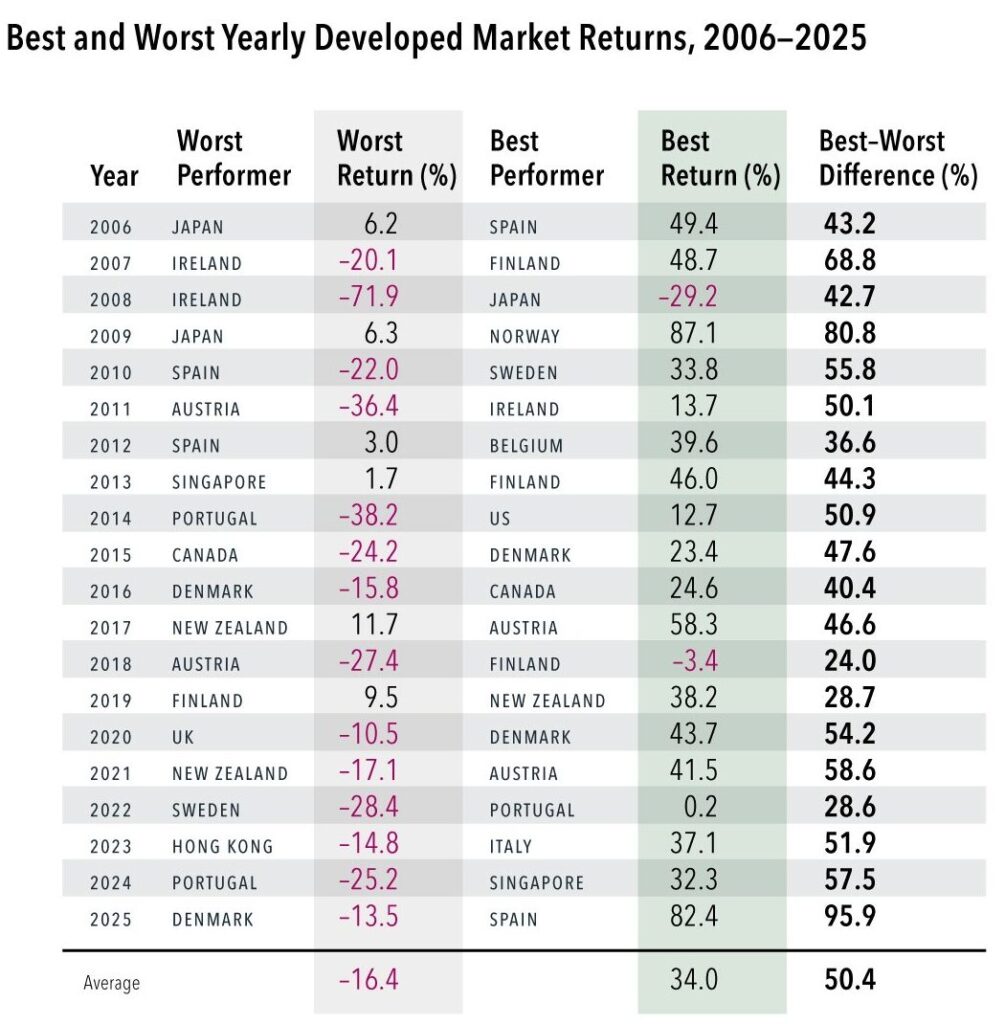
Past performance is not a guarantee of future results. Actual returns may be lower.
In USD. Indices are not available for direct investment; therefore, their performance does not reflect the expenses associated with the management of an actual portfolio. Diversification neither assures a profit nor guarantees against loss in a declining market. MSCI country indices (net dividends) for each country listed. MSCI data © MSCI 2026, all rights reserved.
All expressions of opinion are subject to change. This information is not meant to constitute investment advice, a recommendation of any securities product or investment strategy (including account type), or an offer of any services or products for sale, nor is it intended to provide a sufficient basis on which to make an investment decision. Investors should consult with a financial professional regarding their individual circumstances before making investment decisions. Diversification neither assures a profit nor guarantees against loss in a declining market.
Risks include loss of principal and fluctuating value.
Dimensional Fund Advisors LP is an investment advisor registered with the Securities and Exchange Commission.
Investment products: • Not FDIC Insured • Not Bank Guaranteed • May Lose Value
Dimensional Fund Advisors does not have any bank affiliates.
MARKET EFFICIENCY EXPLAINED: WHY STOCK PRICES BEHAVE THE WAY THEY DO
NVIDIA smashed records and analyst predictions in late May 2026 when the company announced quarterly revenue of $81.6 billion. You might have expected great news like this to send the AI chipmaker’s shares soaring. Instead, they fell. That seemingly illogical result illustrates one of the most important ideas in investing: market efficiency.
The concept, popularized by Nobel Prize-winning economist Eugene Fama, is often misunderstood to mean that markets price stocks perfectly. Some investors might point to market crashes, bubbles and dramatic daily swings as evidence that the efficient market hypothesis must be wrong. But that’s not what the hypothesis actually says. Instead, it states that asset prices reflect all available information about those assets. Understanding that distinction can help investors make better decisions—and perhaps avoid costly mistakes.
MARKETS PRICE THE FUTURE
The stock market is forward-looking: Stock prices are based on what investors collectively expect will happen in the future. Every trading day, millions of investors evaluate earnings reports, economic data, interest rates, new products, geopolitical events and countless other pieces of information. They use this data to constantly update expectations about a company’s future earnings and cash flows. The investments they make based on this new information collectively set the price of the company’s stock.
This constant incorporation of new information is why NVIDIA’s blockbuster report wasn’t enough to send the stock higher. Investors likely anticipated extraordinary results long before the company released them, and those expectations were already reflected in the stock price. When the news arrived, it fell short of what investors had already priced in.
In much of our lives, we’re comfortable with market prices. We rarely question the price of apples at the store, for example. We just assume that the price is what it needs to be, based on supply and demand. Stocks often inspire a different mindset. Many investors approach investing as if the assignment is to outsmart the market—finding hidden bargains or identifying tomorrow’s winner before anyone else does. Sometimes lightning strikes and the stock they pick jumps. But many investors wind up like the ones who bought shares of NVIDIA just before the quarterly announcement expecting an easy win, only to be sorely disappointed.
DON’T VOLATILITY AND BUBBLES PROVE MARKETS ARE INEFFICIENT?
Investors often ask, “If the market is so efficient, why is it so volatile? And how can the market be efficient when history is full of boom-and-bust cycles like the dot-com and real estate bubbles?”
In fact, volatility is exactly what you would expect from an efficient market. Markets are constantly digesting new information. When information changes rapidly, prices should adjust equally fast. Volatility is evidence that market expectations are responding to new data, not that they’re broken. What about bubbles? The efficient market hypothesis says prices reflect all available information. The problem during bubbles is that investors become overly optimistic about what that information means for the future.
A bubble doesn’t mean the market failed; it means investors collectively reached conclusions that turned out to be wrong.
MARKET EFFICIENCY HAS ITS LIMITS
Are markets perfectly efficient? Probably not—and that may be a good thing. Economists Sanford Grossman and Joseph Stiglitz famously identified what has become known as the Grossman-Stiglitz paradox: If markets were perfectly efficient all the time, no investor would have any incentive to spend time researching companies or uncovering new information. After all, if stock prices already reflected everything there is to know, there would be no reward for doing the work.
But if nobody gathered new information, markets would become less efficient over time. Markets need a small amount of inefficiency to motivate investors to seek out new information. Those efforts help keep prices reasonably accurate. Rather than viewing markets as perfectly efficient or hopelessly inefficient, it may be more useful to think of them as highly competitive systems that are constantly moving toward efficiency, even if they never fully arrive there.
WHAT DOES THIS MEAN FOR INVESTORS?
While markets may not be perfectly efficient, you may be better off investing as though they are. Why? To outsmart the market, you would need to have meaningful information no one else has. In 2025, more than 17 billion shares worth more than $1 trillion traded in the U.S. every day, on average. Those trades were conducted by institutional investors, hedge funds, quantitative trading firms, analysts, economists, sophisticated computer models and professional investors around the world, all competing to identify opportunities before everyone else. Finding something they’ve missed may not be impossible, but it’s vanishingly unlikely.
The belief that markets can be outsmarted can lead to counterproductive behaviors. One of the most dangerous is market timing. This is the strategy of making decisions on whether to buy or sell financial assets by attempting to predict future market prices. History suggests timing the market is remarkably difficult to do consistently. Studies have repeatedly found that the average equity investor’s returns tend to trail the S&P 500, largely because poor timing decisions caused them to buy after markets had already risen and sell after markets had already fallen.
Accepting the idea of market efficiency can be surprisingly liberating. During periods of high volatility or big market drops, you can rest assured that the market is doing exactly what it’s supposed to be doing as it incorporates new information. Rather than chasing headlines or trying to predict every market move, you can focus on what you can control: maintaining a diversified portfolio, sticking to a long-term investment plan, keeping costs low, and allowing compounding to work over time. If you have any questions about market efficiency or your portfolio, please don’t hesitate to reach out.
sources: https://nvidianews.nvidia.com/news/nvidia-announces-financial-results-for-first-quarter-fiscal-2027
https://www.google.com/finance/beta/quote/NVDA:NASDAQ?window=YTD
https://www.chicagobooth.edu/review/eugene-fama-efficient-markets-and-the-nobel-prize
https://www.aeaweb.org/aer/top20/70.3.393-408.pdf
https://www.cboe.com/insights/posts/2025-u-s-equities-year-in-review/
https://www.dalbar.com/press-release/dalbars-2026-qaib-report-shows-narrower-investor-gap-amid-a-complex-and-volatile-market-year/
PREPARING FOR MEDICARE: WHAT YOU NEED TO KNOW BEFORE YOU TURN 65
Most people spend decades saving, investing and planning for retirement. But one of the biggest financial decisions of your retirement years has little to do with your portfolio. Rather, it has to do with a government program, an important birthday and a deadline you really don’t want to miss.
That program is Medicare, and you have a short window around your 65th birthday to sign up. Doing so will help you take full advantage of all that Medicare has to offer and give you more flexibility as you navigate healthcare spending in retirement. Here we’ll explain what you need to know about your Medicare benefits and how to prepare.
SIGNING UP FOR MEDICARE
Medicare was created in 1965 to ensure seniors have access to affordable healthcare in retirement. While it isn’t free, you’ve likely already paid for a big chunk of it through decades of payroll taxes—a compelling reason to start taking advantage of your benefits as soon as you’re eligible.
The enrollment window opens three months before the month of your 65th birthday and closes three months after. If you don’t enroll during your Initial Enrollment Period, you could face coverage delays and higher monthly premiums for the rest of your life. These penalties are designed to discourage people from waiting until they get sick to buy coverage. You can enroll and choose plans on the Social Security website.
Note that seniors who continue to receive private health insurance through an employer might be exempt from Medicare enrollment obligations and penalties. It depends on the company’s size and plan details. Let’s take a closer look at each part of Medicare, and what you need to consider.
PART A: HOSPITAL COVERAGE
Part A covers inpatient hospital stays, skilled nursing facility care, hospice services and some home healthcare. For most people, there’s no monthly premium. That’s because Part A is what you funded through payroll deductions, assuming you or your spouse contributed for at least 10 years. But you will be responsible for deductibles: $1,736 in 2026 for the first 60 days of a hospital stay, with substantial copayments beyond that.
Assuming you have paid into Medicare through your lifetime earnings, there’s no financial penalty for delaying Part A enrollment—but also no reason not to enroll.
PART B: OUTPATIENT COVERAGE
Part B covers outpatient services, including emergency room and doctor visits, preventive care, lab work and medical equipment. In 2026, standard monthly premiums for Part B are $202.90, and they can be higher, depending on your income and filing status. There is also an annual deductible of $283, plus a 20% copay for most doctor visits.
Missing your Initial Enrollment Period will add a permanent 10% surcharge to your Part B premium for every full 12-month period delayed.
PART C: MEDICARE ADVANTAGE
Part C, commonly known as Medicare Advantage, refers to optional plans offered by private insurers that combine Parts A and B and sometimes Part D. Part C plans offer lower out-of-pocket costs and have fixed copays for office visits (instead of 20% for Part B), with smaller or no annual deductibles. By law, they must include a maximum annual out-of-pocket cost, which varies depending on whether you see doctors in or outside the plan’s network. The plans may also include benefits like dental, vision and hearing.
When you sign up for Part C, you’ll still need to pay your Part B premium. While you might need to pay an additional premium on top of that, some Medicare Advantage plans charge no additional premium. Television advertising makes it sound like Medicare Advantage plans provide all kinds of extra money for buying groceries, etc.; however, you need to be careful as to where you will be retiring and whether doctors or hospitals you plan to see are covered by Part C. Many rural area hospitals do not accept Medicare Part C. Even though these plans are referred to as Advantage plans, there are some disadvantages to them.
PART D: PRESCRIPTION DRUG COVERAGE
Part D covers prescription drugs, with plans offered through private insurance companies. In 2026, the average monthly Part D premium is $34.50, but it varies based on the plan details and where you live. You may also pay an annual deductible (in 2026, up to $615) and co-insurance on each prescription, which can vary depending on the drug’s “tier” or pricing scale. Note that most Medicare Advantage plans also include Part D coverage.
You won’t have to pay for Part D if you have creditable drug coverage already (from a current employer, for instance) or qualify for extra help. Otherwise, you are required to have Part D, and delaying enrollment will add a permanent 1% surcharge to your premium for every month delayed. There is a period of time each year when you can change the Part D provider. It is wise to check this out, because premiums and net costs for drugs do change each year along with possible changes in your prescriptions.
MEDIGAP: THE FINAL PIECE OF THE PUZZLE
Medigap policies are supplemental private policies that help pay out-of-pocket costs for Parts A and B. They charge higher premiums, sometimes several hundred dollars more a month. However, they fill in the gaps of what isn’t covered by Parts A and B.
You can’t have both Medigap and Medicare Advantage. The Medigap enrollment period is six months beginning the first day you are 65 and have Part B coverage. Enroll in this period and you can’t be denied coverage based on preexisting conditions.
Medicare has a lot of moving parts, and we can help you unpack them. If you have any questions, reach out. After all, understanding Medicare—and when to sign up for what—is good for your health and wealth. With smart preparation, you’ll almost certainly pay less for healthcare in retirement, even as your medical needs grow.
sources:https://www.cms.gov/about-cms/who-we-are/history
https://www.ssa.gov/medicare/sign-up
https://www.cms.gov/newsroom/fact-sheets/2026-medicare-parts-b-premiums-deductibles
https://www.medicare.gov/basics/costs/medicare-costs
https://www.ncoa.org/article/medicare-advantage-medicare-part-c-costs/
https://www.cms.gov/newsroom/press-releases/medicare-advantage-medicare-prescription-drug-programs-expected-remain-stable-2026
https://www.medicare.gov/health-drug-plans/part-d/basics/costs
https://www.medicare.gov/basics/costs/medicare-costs/avoid-penalties
WE ARE HERE TO HELP
“We are here to help.” We often say this in our articles and letters that we provide you with. We are not saying that we will make decisions for you, but we will try to help provide valuable information so that you can make an informed decision. There is a lot of information floating around out there, and we try to discern what is the proper information for you and your situation.
So let us know if you have any concerns or questions. We are here to help. Have a great fall!
Investments provided through McMill Wealth Inc, a Nebraska Corporation, Registered Investment Advisor
This material is derived from sources believed to be reliable, but its accuracy and the opinions based thereon are not assured.
The articles and opinions in this publication are for general information only and are not intended to serve as specific financial, accounting or tax advice